Safe Vegetable Fermentation at Home
This article was generated with AI assistance and may contain mistakes. Verify food-safety details against the linked primary sources before fermenting at home.
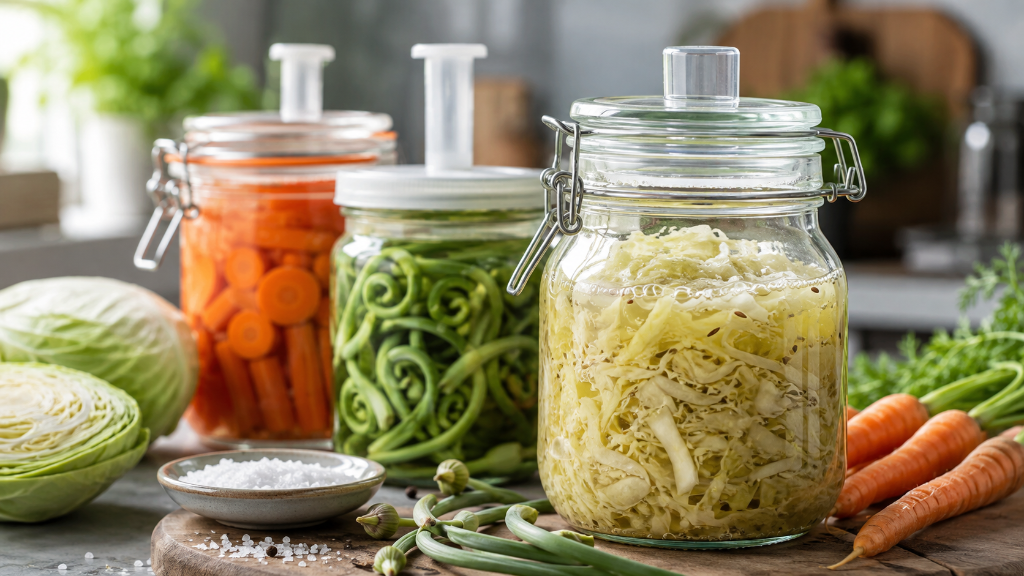
Safe Vegetable Fermentation
A practical guide to fermenting cabbage, carrots, garlic scapes, and similar vegetables
with the controls that matter: salt, submersion, temperature, time, acidity, and cold storage.
The bottom line
Discard the entire batch if it is slimy, smells spoiled or rotten, has fuzzy or coloured mold,
or cannot reach pH 4.6 or lower. “When in doubt, throw it out” is the correct food-safety rule.
A healthy ferment commonly has
- Fine bubbles, fizz, or a gently pressurized airlock
- Cloudy brine or harmless pale sediment
- A clean, pleasantly sour, vegetal aroma
- Gradually increasing tartness
- Firm vegetables that remain below the brine
- A measured final pH of 4.6 or lower
Discard the batch when you see
- Fuzzy, hairy, raised, or coloured growth
- Pink, orange, black, blue, or green mold-like patches
- Slime, ropiness, or vegetables breaking down abnormally
- Rotten, putrid, fecal, rancid, or otherwise repulsive odour
- A dead ferment that remains above pH 4.6
- Any contamination from a non-food-safe or reactive vessel
It does not cover meat, dairy, fish, eggs, kombucha, alcohol, garlic-in-oil, vacuum-sealed
low-acid foods, or room-temperature canning. Those require different controls.
Why the method works
Naturally present lactic-acid bacteria consume vegetable sugars and make lactic acid.
Salt favours the desired fermentation community, draws liquid from plant tissue, and slows
many competing organisms. Submersion limits oxygen-loving molds and yeasts. The falling pH
creates an environment in which dangerous organisms are much less able to grow.
Salt selects
Too little salt can allow spoilage organisms to dominate. Too much can suppress fermentation. Use the amount specified by a research-based method.
Brine excludes oxygen
Vegetables exposed above the liquid are the usual starting point for mold and surface yeast. A proper weight is not optional.
Acid confirms completion
Bubbles and a sour smell are useful signs, but pH is the objective safety check. The target is pH 4.6 or lower.
Equipment that reduces failure
Recommended
- Digital kitchen scale accurate to 1 gram
- Clean glass jar, food-grade crock, or food-grade plastic vessel
- Fermentation weight that fits the vessel
- Airlock lid, especially for small Mason-jar batches
- Digital thermometer for the fermentation area
- Calibratable digital pH meter, ideally with pH 4 and 7 buffers
- Canning or pickling salt
- Soft, distilled, or otherwise suitable low-mineral water
Avoid
- Garbage bags, trash liners, or unknown plastics
- Cracked crocks, chipped enamel, or damaged jars
- Brass, copper, iron, zinc, galvanized metal, or unknown reactive metals
- Salt substitutes containing potassium chloride
- Guessing salt by handfuls or changing a tested recipe
- Sealing a standard jar tightly and then forgetting to vent pressure
- Oil in a room-temperature vegetable ferment
Wash vessels, weights, tools, hands, and work surfaces with hot soapy water and rinse well.
Sanitize equipment when practical, but rinse away sanitizer residue that could inhibit the desired bacteria.
The safe workflow
Choose excellent produce
Use fresh, firm vegetables without rot, deep bruises, or mold. Remove damaged portions generously. Rinse under cool running water and remove visible soil.
Choose the correct method
Use dry salting for finely shredded vegetables. Use a measured wet brine for whole vegetables, sticks, chunks, and firm stems.
Measure salt accurately
Use canning or pickling salt. For a published recipe, follow its exact amount. For the general large-piece method in this guide, use the 5% Extension brine equivalent.
Pack and submerge
Pack firmly enough to remove large air pockets. Cover all solids with 2.5–5 cm (1–2 in) of brine and hold them down with a clean weight.
Limit oxygen but manage pressure
Use an airlock or a vessel designed for fermentation. If using a plain lid, vent it briefly as needed; carbon dioxide can create considerable pressure.
Hold 20–22°C and keep it dark
A cool, steady location gives better control. Above about 26°C (78°F), over-fermentation and spoilage become more likely; below about 16°C (60°F), fermentation may stall.
Observe and measure
Check submersion, temperature, aroma, and activity. Measure pH during fermentation. Do not rely only on a calendar or taste.
Finish at pH 4.6 or lower
When active bubbling has stopped and the brine is pH 4.6 or lower, transfer the ferment to refrigeration. Keep vegetables covered by brine during storage.
Salt: the control most often mishandled
Salt is part of the preservation system, not merely seasoning. Different salts occupy different
volumes, so weighing is more dependable than spoon measures. When a tested recipe specifies
canning or pickling salt by volume, use that salt and that measure.
| Method | Extension equivalent | Use it for | Important limit |
|---|---|---|---|
| 3% wet brine | 27 g salt per 1 US quart / 946 mL water | Shredded or relatively small-cut vegetables where a wet brine is appropriate | Not a substitute for the tested sauerkraut recipe below |
| 5% wet brine | 45 g salt per 1 US quart / 946 mL water | Large pieces and firm vegetables such as carrot sticks; used here conservatively for garlic scapes | Do not reduce the salt because the result “tastes too salty” |
| USDA sauerkraut | 3 level tbsp canning/pickling salt per 5 lb / 2.27 kg cabbage | Finely shredded cabbage packed in its own expressed juice | Follow the recipe rather than a generic percentage |
Wet-brine calculator
Scales the University of Illinois Extension gram equivalents. Measure the water first, then dissolve the calculated salt.
canning or pickling salt
for 1,000 mL water using the 5% Extension equivalent
Plain water dilutes the protective salt concentration. Make extra brine at the same concentration
used for the batch. For the USDA sauerkraut recipe, its specified top-up is 1½ tablespoons
canning/pickling salt per US quart of boiled and cooled water.
Reliable starting methods
The cabbage method is the USDA/National Center for Home Food Preservation recipe.
The carrot and scape methods apply current Extension guidance for large vegetable pieces and
require pH verification. They are refrigerator ferments, not shelf-stable canned products.
Classic sauerkraut
USDA-tested method
Dry salted
3–6 weeks depending on temperature
For each batch
- 5 lb / 2.27 kg firm fresh cabbage
- 3 level tbsp canning or pickling salt
- Optional top-up: 1½ tbsp salt per 1 US quart / 946 mL boiled, cooled water
Do not use the generic brine calculator for this recipe.
Method
- Discard damaged outer leaves. Rinse and drain. Quarter, core, and finely shred the cabbage.
- Work with 5 lb at a time. Add 3 level tablespoons canning/pickling salt and mix thoroughly with clean hands.
- Pack firmly into the vessel until juice is drawn out. Continue until the vessel is about three-quarters full, leaving generous headspace.
- The juice must cover the cabbage. If it does not, add only the specified boiled-and-cooled top-up brine.
- Weight the cabbage so it remains 2.5–5 cm below the liquid. Fit an airlock or appropriate cover.
- Ferment at 21–24°C (70–75°F) for roughly 3–4 weeks. At 16–18°C (60–65°F), it may require 5–6 weeks. Avoid temperatures above 24°C for best texture.
- Refrigerate when bubbling has ceased and pH is 4.6 or lower.
Fermented carrot sticks
Extension large-piece method
5% wet brine
pH verification required
For a 1 L jar
- Fresh, firm carrots, enough to pack the jar without crushing
- 5% brine: 45 g salt per 946 mL water, scaled as needed
- Optional whole spices: peppercorns, dill seed, mustard seed, coriander
- Optional small piece of fresh ginger or a clean garlic clove
Method
- Rinse carrots thoroughly, trim the ends, and cut into evenly sized sticks or coins. Discard soft or damaged pieces.
- Dissolve the measured salt completely in suitable water. Cool the brine if you warmed it.
- Pack carrots and optional whole spices into the clean jar, leaving headspace.
- Pour in brine, release trapped air, and install a weight. Keep carrots 2.5–5 cm below the brine.
- Fit an airlock. Ferment in the dark at 20–22°C. Check daily that nothing is floating above the brine.
- Begin pH checks once fermentation is visibly active and the aroma is pleasantly sour. Continue until pH is 4.6 or lower and active bubbling has stopped; a full ferment may take several weeks.
- Refrigerate promptly. Keep the carrots submerged when serving from the jar.
Fermented garlic scapes
Conservative application of large-piece guidance
5% wet brine
Refrigerator storage
For the vessel
- Very fresh, firm garlic scapes without decay
- 5% brine: 45 g salt per 946 mL water, scaled as needed
- Optional whole spices such as dill seed, coriander, or peppercorns
Do not add oil. Garlic or herbs held in oil require a separate, validated acidification method.
Method
- Rinse scapes, trim dry ends and flower tips, and cut into uniform lengths that fit below the jar shoulder.
- Pack into a clean vessel with optional whole spices. Avoid overfilling.
- Cover with measured 5% brine. Remove air pockets and apply a fitted fermentation weight.
- Keep every piece below 2.5–5 cm of brine and fit an airlock.
- Ferment at 20–22°C in the dark. Monitor aroma, activity, temperature, submersion, and pH.
- Refrigerate only after pH reaches 4.6 or lower and active bubbling has stopped.
Colour note: garlic-family vegetables may develop blue or green tones in acidic conditions. Colour alone can be a harmless pigment reaction; discard if it accompanies mold, slime, or an offensive odour.
Whole spices, dill, ginger, and hot peppers can change flavour. They do not replace salt,
submersion, temperature control, pH measurement, or refrigeration. Start with modest amounts
and use only fresh, sound ingredients.
Monitoring: what to record and when
At setup
During fermentation
Follow the meter manufacturer’s calibration and cleaning instructions. Test a representative
brine sample with a clean utensil rather than dipping a dirty probe repeatedly into the jar.
Record the value. If bubbling stops while pH remains above 4.6, continue and recheck every
1–2 days; if the batch remains inactive or develops any spoilage sign, discard it.
What is normal, what needs correction, and what means discard
Cloudy brine
Often normal during active fermentation. Lactic-acid bacteria and suspended plant material can make the liquid cloudy.
White sediment
Commonly bacterial sediment. Judge it together with pH, aroma, texture, and the absence of mold.
Blue-green garlic tones
Can be a harmless reaction of garlic pigments in acid. Colour alone is not evidence of spoilage.
Floating pieces
Push them below the brine with a clean utensil or replace the weight. Repeated exposure invites surface growth.
Low brine level
Add freshly prepared brine of the same concentration. Never dilute with plain water.
Room too warm
Move the vessel to a cooler, dark location. Warm conditions speed fermentation but can soften vegetables and raise spoilage risk.
Fuzzy or coloured mold
Discard the entire batch. Do not scrape the top and assume the submerged portion is safe.
Slimy or ropy texture
Discard. This is a recognized spoilage sign, especially when accompanied by soft vegetables or an unpleasant odour.
Rotten odour or failed acidification
Discard if it smells spoiled or remains above pH 4.6 after activity has stopped. Do not “rescue” it with vinegar after the fact.
Finishing and storage
Refrigerator storage
- Move the finished ferment to the refrigerator once pH is 4.6 or lower and active bubbling has stopped.
- Keep the jar covered and the vegetables below the brine.
- Use clean utensils every time; do not eat directly from the jar and return the utensil.
- Check aroma, surface, and texture whenever the jar is opened.
- University of Minnesota Extension states properly fermented produce may be refrigerated for up to nine months; quality is generally best earlier.
Shelf-stable storage
Fermentation alone does not make a jar safely shelf-stable in a home pantry.
- Use a research-tested boiling-water canning recipe and its exact processing time if you want shelf-stable storage.
- Do not invent a canning process for carrots, scapes, mixed vegetables, or garlic.
- Heat processing changes texture and kills live fermentation organisms, but it is the validated process—not the live culture—that creates pantry stability.
Printable batch log
One row per observation makes failed batches easier to diagnose and successful batches easier to repeat.
| Batch / vegetable | Start date | Salt method & amount | Temperature | pH | Activity, aroma, surface, texture | Action |
|---|---|---|---|---|---|---|
Primary sources and further reading
The methods and safety thresholds in this guide are drawn chiefly from USDA-backed home-food-preservation
material, university Extension publications, and Canadian federal and provincial food-safety resources. Accessed 1 August 2026.
-
University of Minnesota Extension — Preserving food at home: Fermentation
Food selection, temperature, brining ranges, airtight vessels, pH 4.6 endpoint, refrigeration, and storage guidance. Reviewed 2026. -
National Center for Home Food Preservation — Sauerkraut
USDA cabbage-to-salt ratio, top-up brine, fermentation temperatures and times, and optional tested canning process. -
NCHFP — Suitable containers, covers, and weights
Food-safe vessels, cleaning, weights, brine depth, and the warning against garbage bags or trash liners. -
University of Illinois Extension — Fermenting
3% and 5% brine equivalents, submersion, temperature control, spoilage prevention, and discard signs. -
NCHFP — Problems with fermented pickles
Weak brine, high temperature, insufficient brine, reactive metals, soft/slippery pickles, and sediment. -
Oregon State University Extension — Pickling vegetables
Research-based pickling principles, safe equipment, weights, garlic colour changes, and processing cautions. -
NCHFP — General information on pickling
Distinguishes fermented pickles from acidified pickles and provides tested home-preservation context. -
Government of Canada — Food safety
Federal food safety information from Health Canada and the Canadian Food Inspection Agency, covering safe food handling, storage, and preparation. -
Health Canada — General food safety tips
Handling, storing, and preparing food safely at home, including temperature guidance and cross-contamination prevention. -
Health Canada — Food safety for fruits and vegetables
Safe handling of produce, including the risks of vegetables and herbs stored in oil — directly relevant to garlic scapes and flavoured oils. -
HealthLink BC — Home canning: How to avoid botulism
British Columbia’s public health resource on safe home preservation, the botulism risk in low-acid foods, and why fermentation alone does not make a product shelf-stable. -
Cultures for Health — Natural fermentation guide
A accessible public resource covering lactic-acid fermentation basics, equipment, vegetable fermentation tips, and troubleshooting for home fermenters. -
Cultures for Health — Lacto-fermentation recipes
Practical recipes for fermenting vegetables, including sauerkraut, pickles, and mixed vegetable ferments with step-by-step instructions. -
Wild Fermentation (Sandor Katz)
Sandor Ellix Katz’s community resource — one of the most widely referenced public fermentation sites, covering vegetable ferments, troubleshooting, and the cultural context of fermented foods. -
The Fermentation Podcast
A long-running podcast and resource hub with interviews, guides, and practical tips for home fermenters, covering vegetable ferments, equipment, and food safety considerations. -
Bernardin — Pickle recipes (Canadian)
Tested pickle and relish recipes from Canada’s leading home-canning brand, including acidified (vinegar-based) pickles that complement the fermentation methods in this guide.
Research-tested recipes exist for sauerkraut and fermented cucumber pickles. Guidance for many other
vegetables is broader rather than recipe-specific. That is why this guide uses conservative salt,
temperature, submersion, pH, and refrigeration controls—and labels the scape method as an application
of general Extension guidance rather than a validated shelf-stable recipe.