Restyling a Racing Film with Local ComfyUI: Charcoal and Photographic Studies
A working experiment, not a finished film. Everything below was restyled locally on a Radeon RX 6700 XT with ComfyUI and FLUX.2 Klein 4B in a low-VRAM configuration. The source is my own render from Every Run — Extended Tour v2.
I took twelve seconds out of a seventy-four-second racing film I had already rendered — 00:29 to 00:41, 720 frames at 60 fps — and asked a local image model to repaint it two ways: as charcoal and oil pastel on pale paper, and as a photographic study meant to sit close to real footage.
The question I cared about was narrower than can it restyle a shot? Striking stills are easy now. It was: can it keep the cars recognizable in motion? That is where these models come apart, so most of what follows is about what survived when the clip actually plays.
The same twelve seconds, three ways
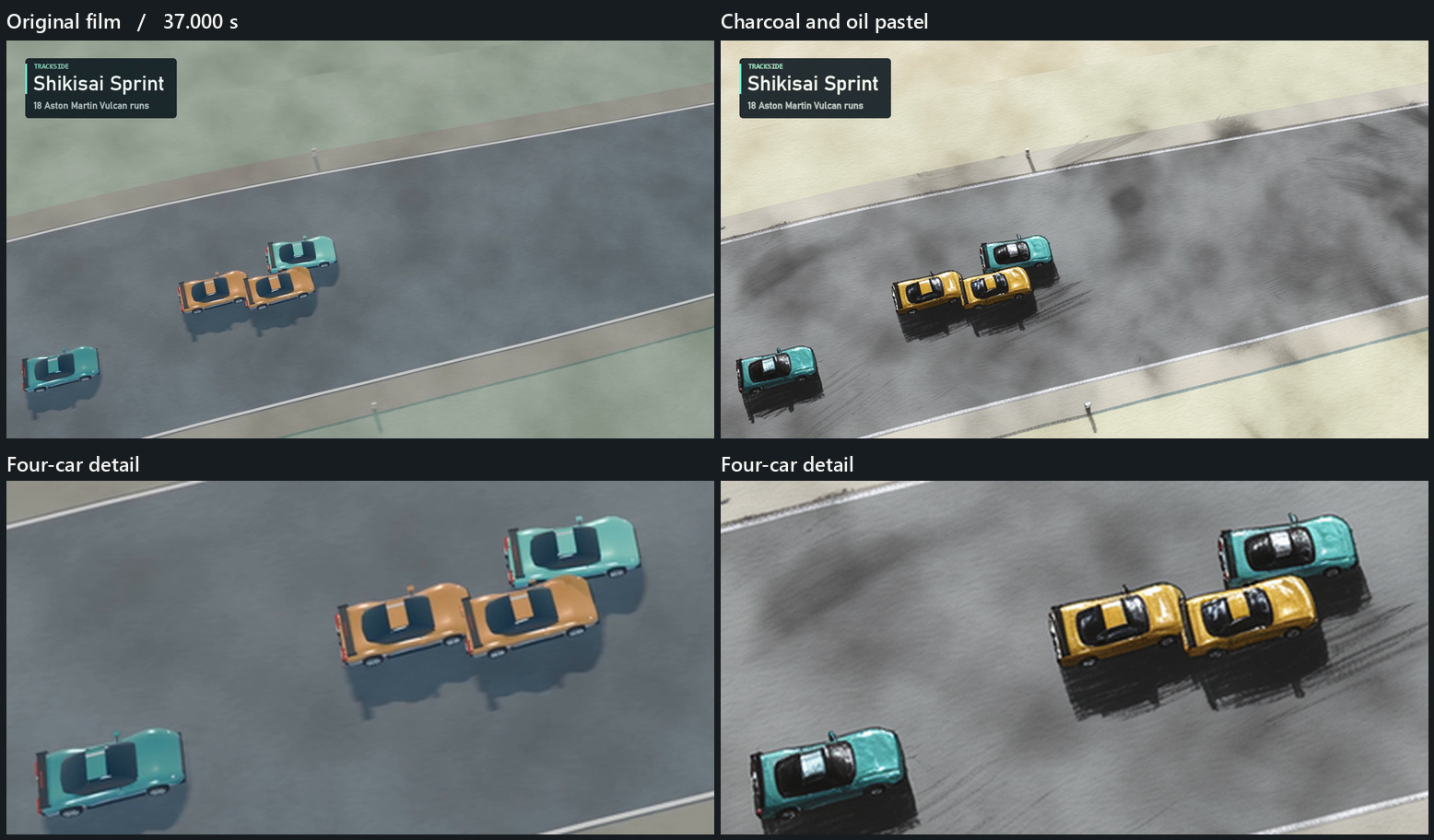
Charcoal: the one that holds up
The charcoal pass is the result I would show someone first. The scenery goes loose and confident — a few strokes for the forest edge, the road reduced to tone and direction — while the cars stay glossy and coloured. That contrast is doing real work: it keeps your eye on the vehicles, which is exactly where a restyle usually loses you.
The original titles and speed readout are composited back over the artwork, so you are watching the same shot, recorded at the same 323 km/h, in a different medium. Removing them would have made it a mood piece; keeping them makes it an honest comparison.
Photographic: convincing still, less convincing motion
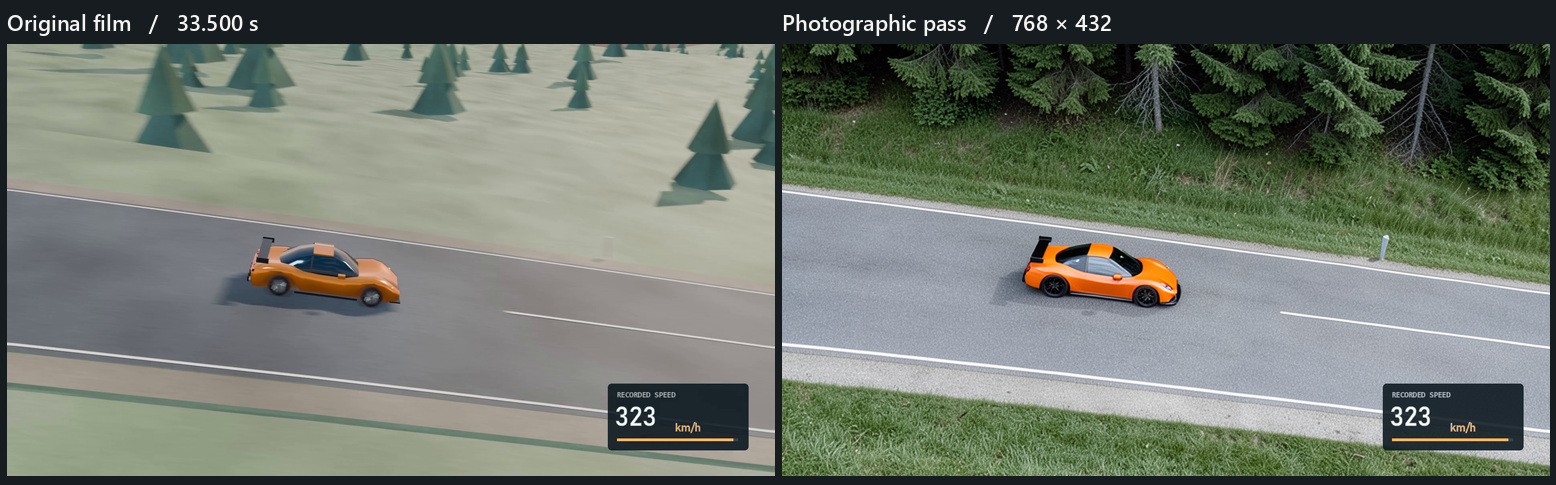
The photographic still translated the road and the forest edge in a way that reads as footage rather than as a filter. That part was never the problem.
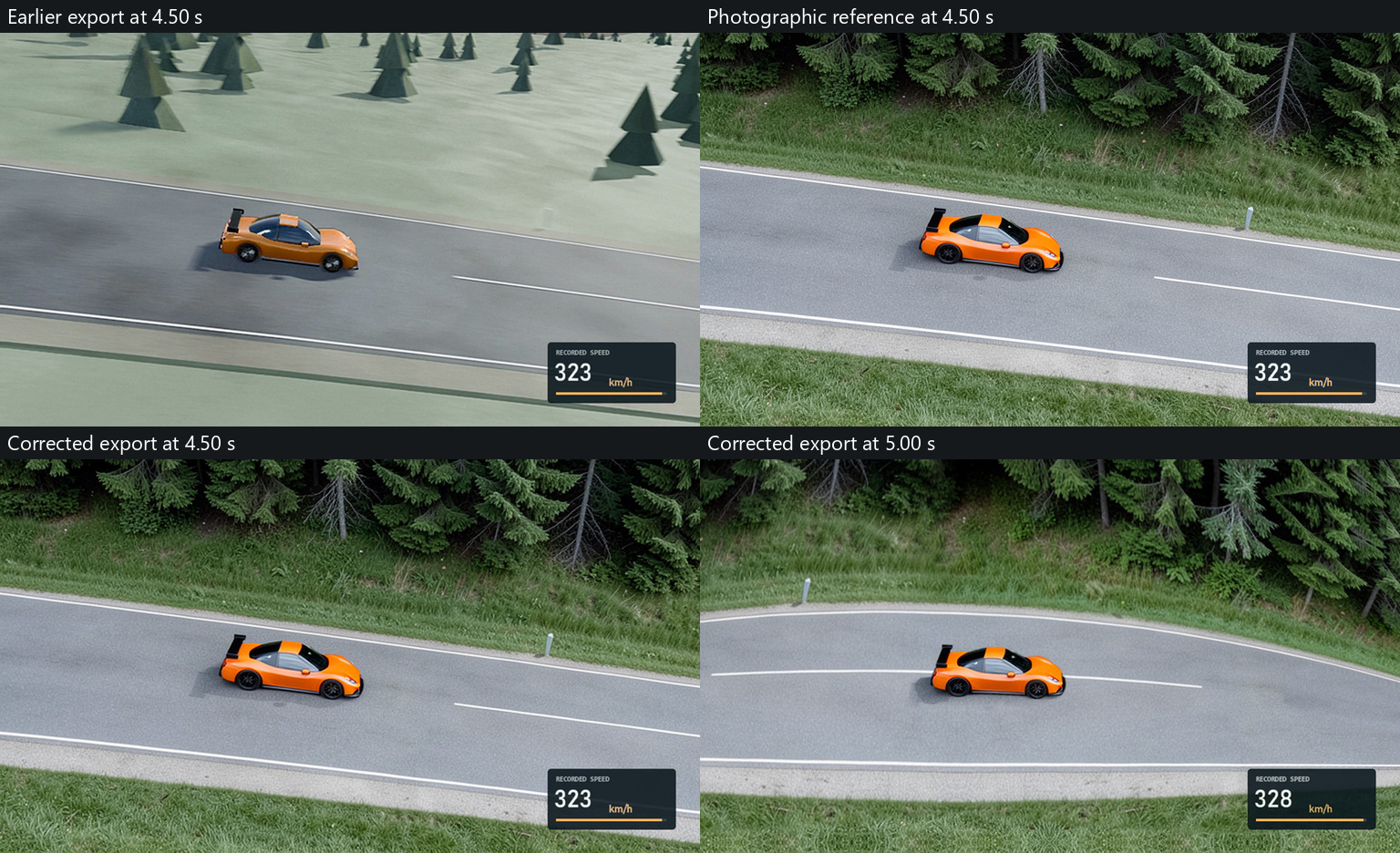
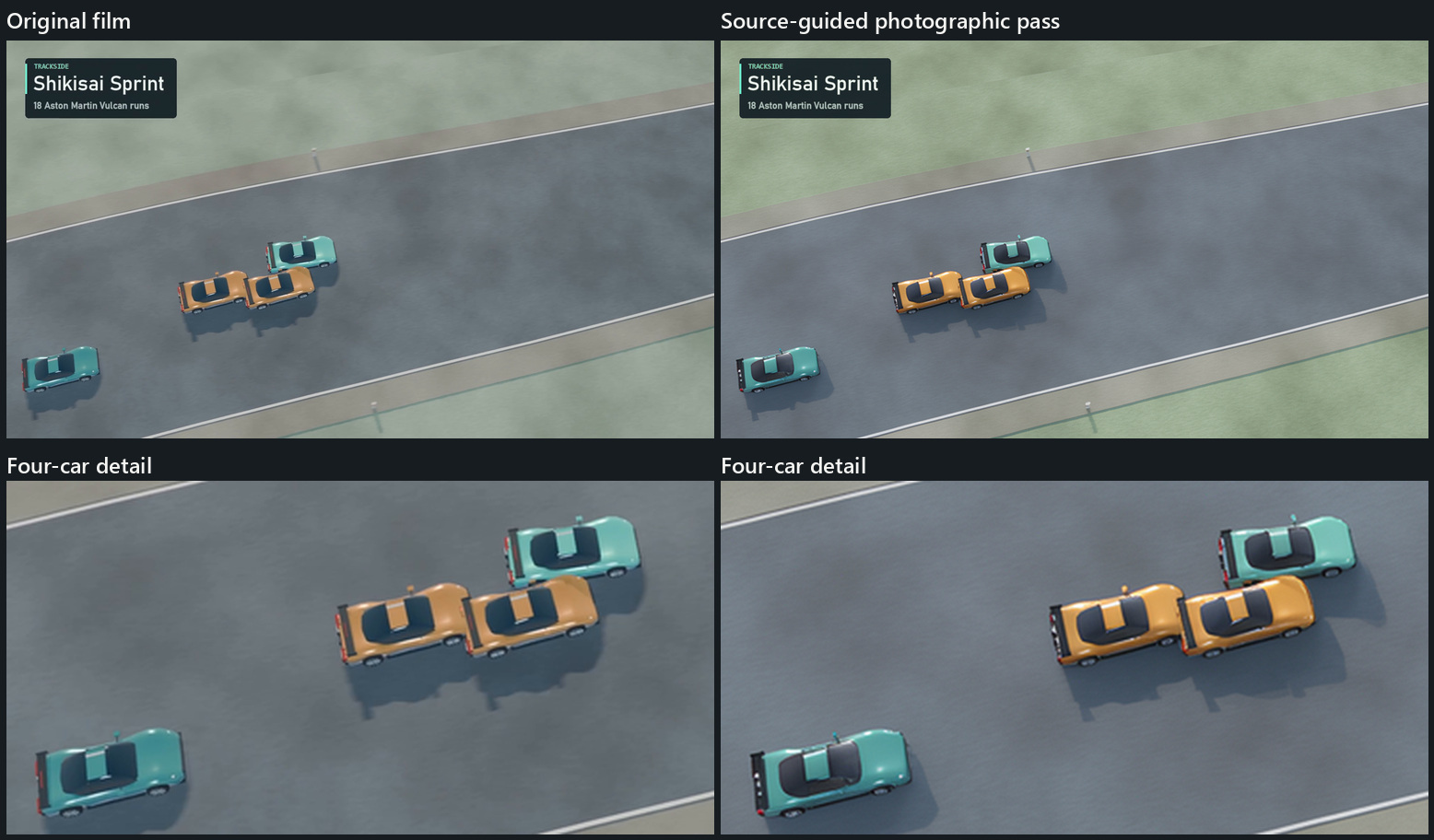
The first animation was. Stronger source guidance pulled the original polygonal scenery straight back in, and a colour-based fallback between keyframes made the seams worse rather than better. You end up with photographic grass sitting on top of a landscape that still looks modelled.
Revision 2 is the honest improvement. I reused the actual Ito pilot, tracked the car, and split the problem: photographic scenery where the environment matters, source-guided vehicles wherever the car count or paint colour started to drift. The close-up and wide shots reuse photographed car views; the roadside pass keeps more of the source vehicles’ rendered appearance.
How the clips were made
The short version
- Motion and composition: clean camera plates supplied both. The charcoal pass used rendered keyframes plus optical flow measured on the original frames.
- Restyle: ComfyUI with FLUX.2 Klein 4B, low-VRAM configuration, on a Radeon RX 6700 XT.
- Resolution: assembled at 768×432, then enlarged to 1920×1080 with Lanczos. The native-size edits are in the archive, not here.
- Overlay: the original titles and telemetry were composited over the artwork rather than regenerated.
Those choices matter when you judge the animation against a single still. An upscale from 768×432 will not survive close inspection, and the vehicle handling changes shot to shot because the car count and paint colour kept drifting — which is why some shots use photographed car views and others fall back to source-guided vehicles.
What I would try next
- Generate at output resolution. Most of the softness in these clips is upscale, not the model.
- Push temporal consistency over the whole shot rather than per-keyframe, so the tracker stops being the thing that decides whether a car keeps its shape.
- An ink-blot watercolour pass — a proposal I never got to. It is the idea that best suits the marbling-like behaviour these models already show at frame edges.
Source footage and restyles: my own render from Every Run — Extended Tour v2, restyled locally. The full archive — the 15-second experiment, native-size edits, the 74-second source film, 900 clean plates, ComfyUI graphs and prompts, and the assembly scripts — is kept locally and is not published here.