From Hemlock Ravine Fungi to a Tapestry Concept
A WALK IN THE WOODS · HALIFAX, NOVA SCOTIA
Fungi of
Hemlock Ravine
Colours, clusters and small discoveries on the forest floor.
Photographed in Hemlock Ravine Park, Halifax. Beneath each image is a tentative identification based on what is visible, with the confidence and the limits of that assessment.
Reading confidence: High = distinctive at the stated level; moderate = plausible with missing details; low = several possibilities. A high rating for a fungal form does not mean a confirmed species. These are qualitative judgments, not measured probabilities.
A photographic nature notebook. Identifications are provisional and must not be used to judge edibility.
Select any photograph to enlarge it
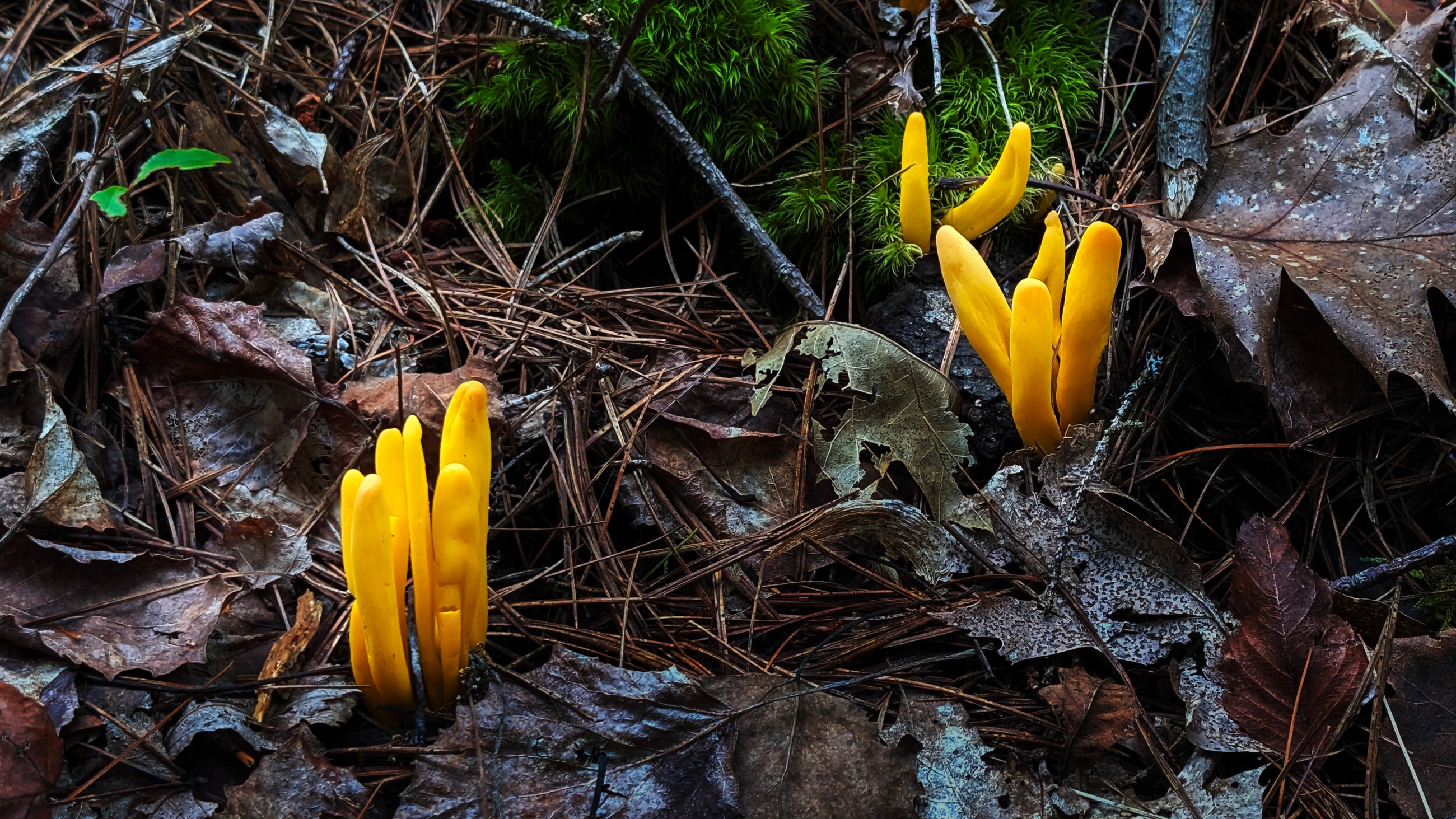
Golden spindle-like club fungi
Clavulinopsis sp.; C. fusiformis is a candidate
Genus candidate; species unresolved
Two groups of yellow clubs rising through the forest floor.
Evidence, uncertainty & references
Why this identification: Upright yellow clubs occur together among moss and leaf litter. The shape and clustered habit suggest Clavulinopsis.
What remains uncertain: C. fusiformis is plausible, but the blunt, flattened tips and unknown size prevent a secure species assignment. Other yellow club fungi remain possible; spores would help.
Compare: Clavulinopsis fusiformis
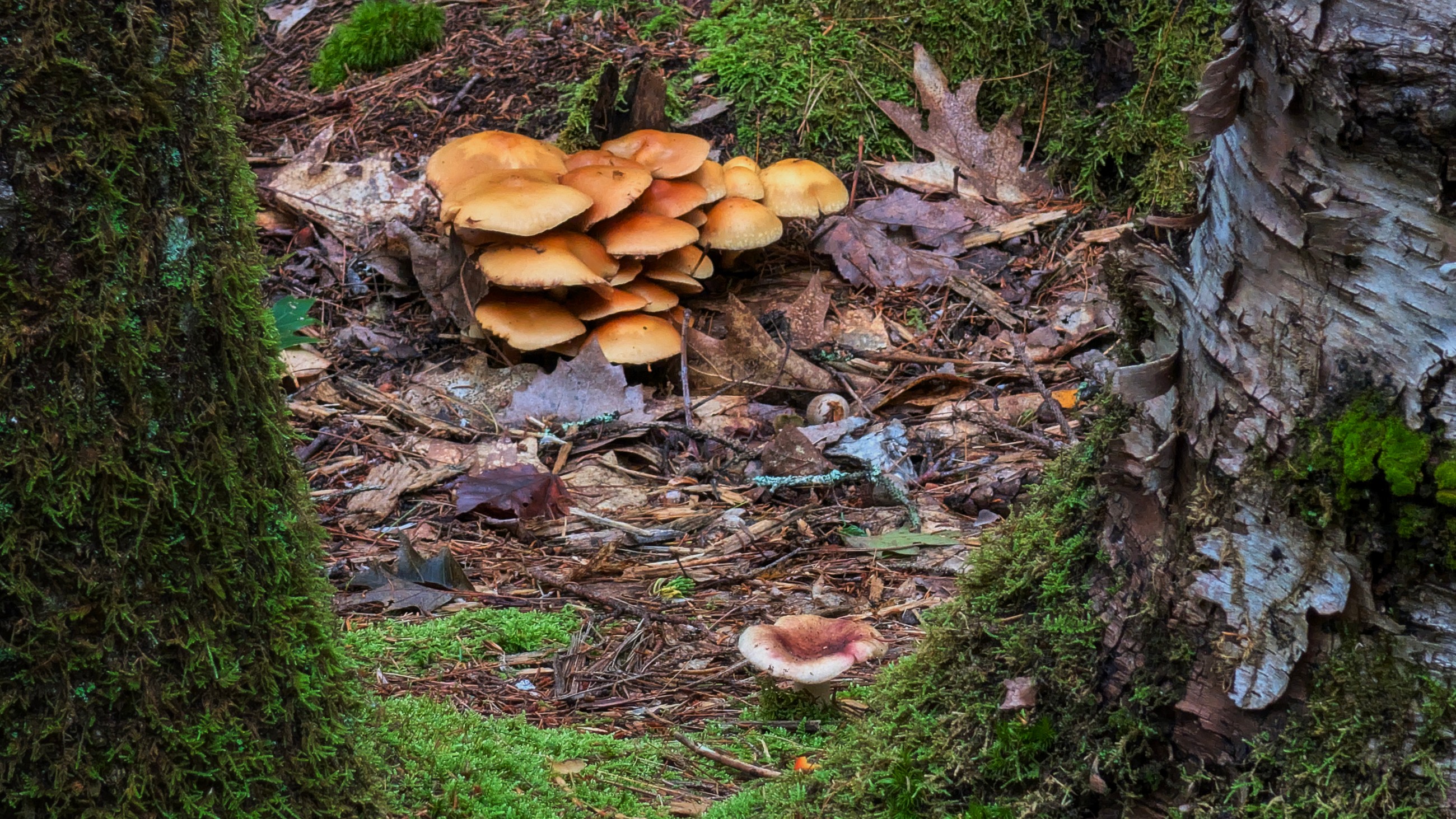
Amber woodland cluster — unresolved
Gilled mushrooms; possible Armillaria or Hypholoma
Candidate genera only
Amber cluster in the background. The separate reddish foreground mushroom may be a Russula, with low confidence; it is not included in the cluster identification.
Evidence, uncertainty & references
Why this identification: Overlapping orange-brown caps form a dense cluster beside a tree. Pale cap edges and some darker centres are visible.
What remains uncertain: The gills, stems and attachment to wood are hidden. Honey mushrooms and brick-cap relatives are comparison candidates, not identifications. An underside view and spore print would be decisive next evidence.
Compare: Honey mushroom comparison · Brick-cap comparison
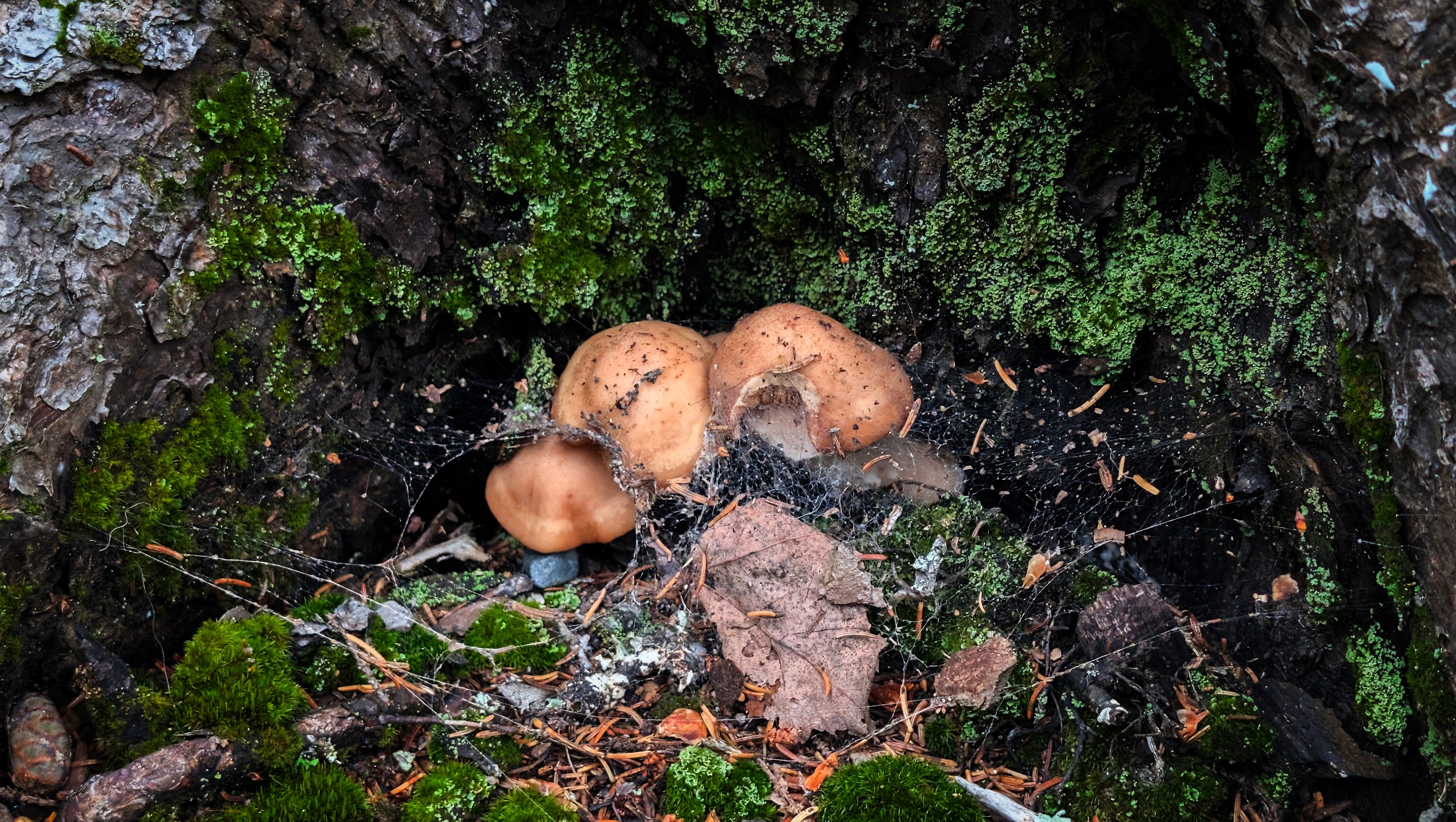
Brown mushrooms at a tree base — unresolved
Mushrooms; genus undetermined
Insufficient diagnostic detail
A small brown cluster tucked into a mossy tree base.
Evidence, uncertainty & references
Why this identification: Several brown caps sit at a mossy tree base, partly obscured by leaves and an actual spider web. A greyish stem is visible, but the underside is not.
What remains uncertain: Tree-base position alone does not establish a wood-decaying species. Armillaria is one comparison, but there is too little evidence to select a genus. The spider web is not a fungal veil.
Compare: Honey mushroom comparison

Scarlet-orange waxcaps
Likely Hygrocybe spp.; H. coccinea is a candidate
Genus likely; species unresolved
The clearest habitat view of the red-orange mushrooms, with several exposed undersides. Group confidence is higher here than in the distant scene.
Evidence, uncertainty & references
Why this identification: Red-orange caps and similarly coloured slender stems suggest waxcaps. In the wider view, exposed yellow-orange gills add support.
What remains uncertain: H. coccinea is a plausible smooth-capped candidate. H. miniata and other red waxcaps remain possible. Cap texture, gill attachment, measured size and spores are needed; similar colour does not prove every photographed cluster is the same species.
Compare: Hygrocybe coccinea · Hygrocybe miniata
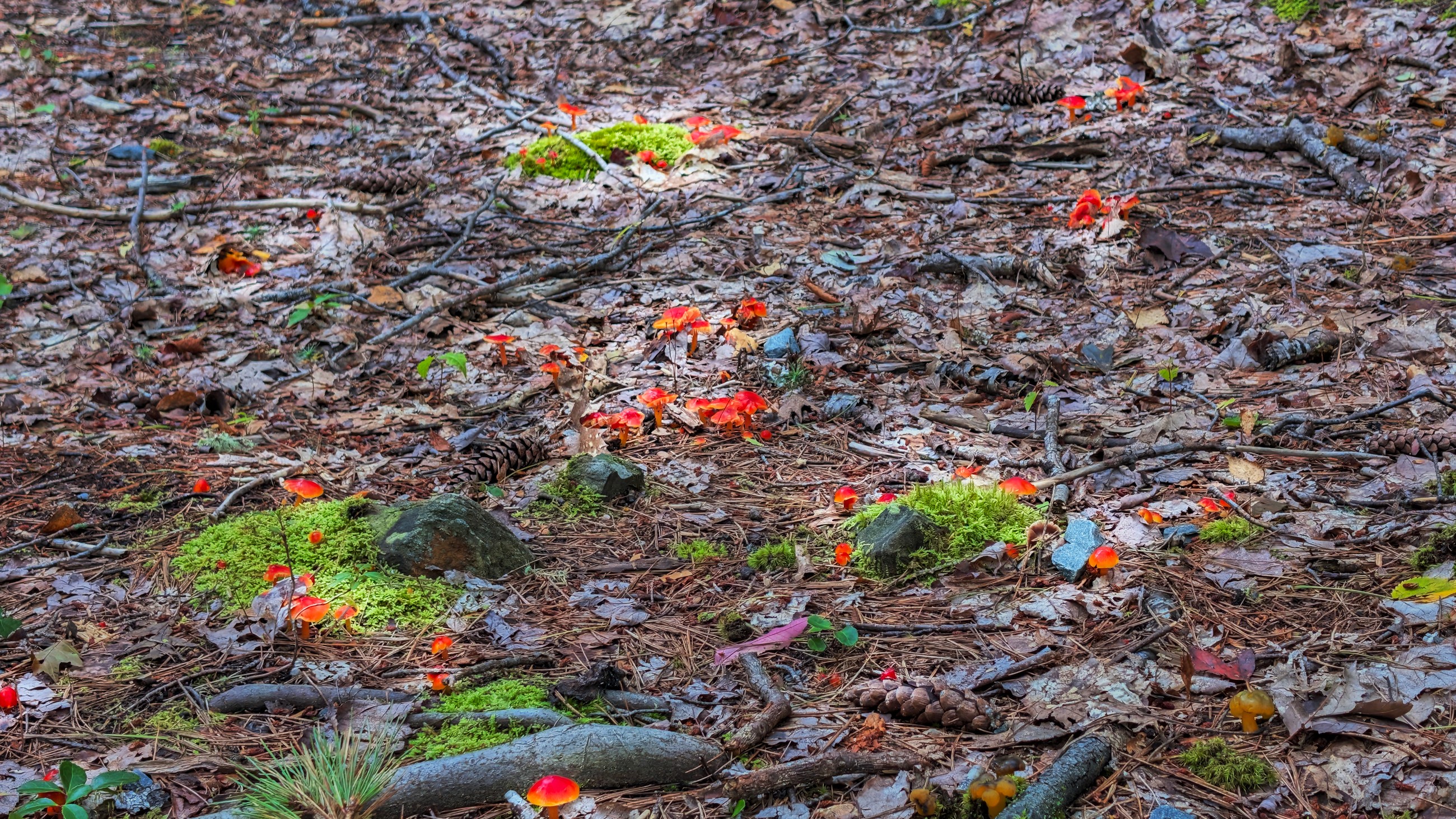
Scarlet-orange waxcaps
Likely Hygrocybe spp.; H. coccinea is a candidate
Genus likely; species unresolved
A broad view of numerous red-orange caps. These likely correspond to the nearby waxcap photographs; distant yellow mushrooms at lower right are not identified. (Note: the mushrooms were brightened in post to enhance visibility.)
Evidence, uncertainty & references
Why this identification: Red-orange caps and similarly coloured slender stems suggest waxcaps. In the wider view, exposed yellow-orange gills add support.
What remains uncertain: H. coccinea is a plausible smooth-capped candidate. H. miniata and other red waxcaps remain possible. Cap texture, gill attachment, measured size and spores are needed; similar colour does not prove every photographed cluster is the same species.
Compare: Hygrocybe coccinea · Hygrocybe miniata
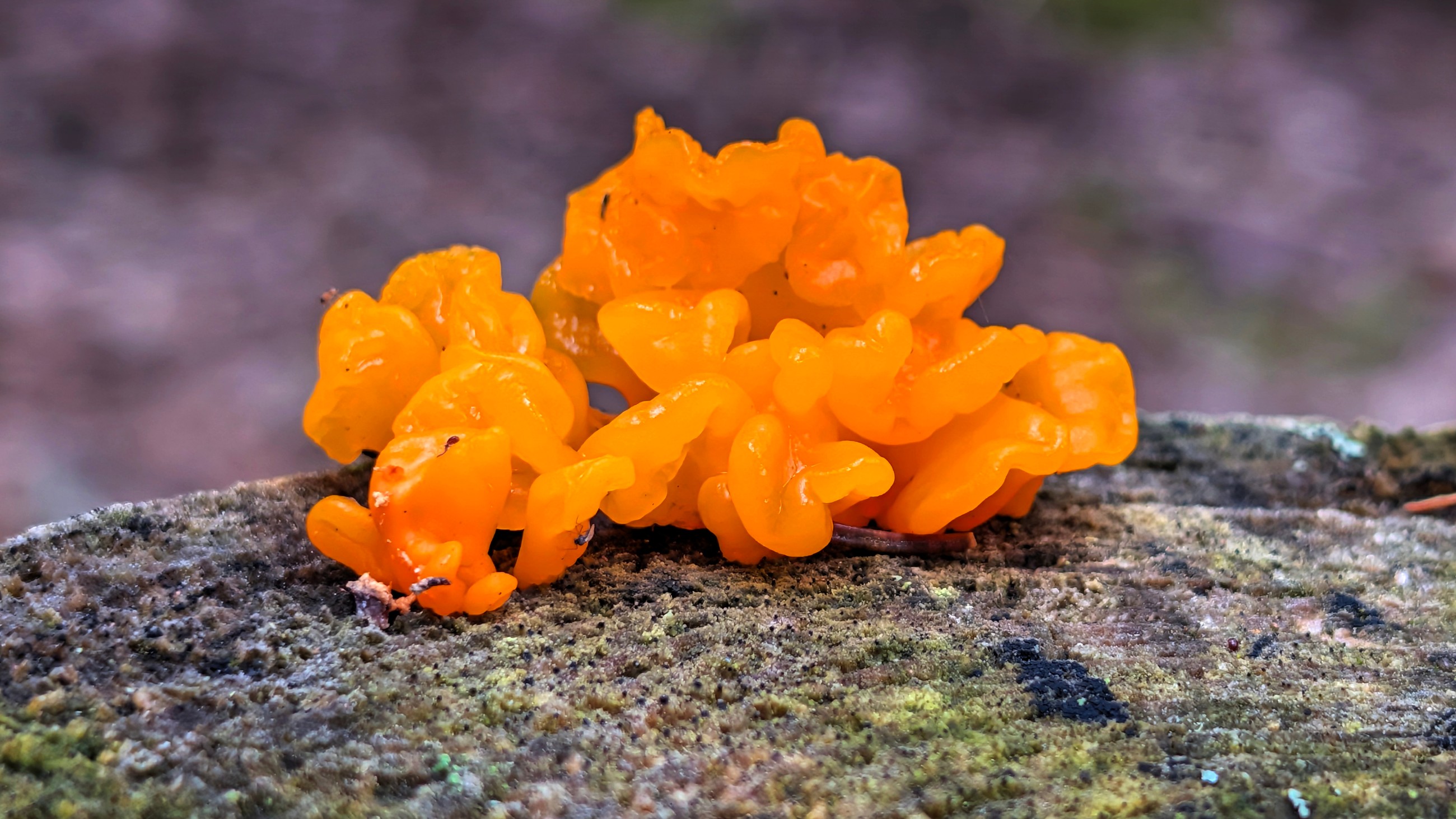
Orange jelly fungus
Dacrymyces / Tremella-like jelly fungus
Jelly-fungus form; genus confidence low
Close detail of the orange gelatinous-looking lobes on a fallen piece of wood.
Evidence, uncertainty & references
Why this identification: A vivid orange, translucent-looking mass of rounded, folded lobes sits directly on dead wood. The jelly-fungus appearance is distinctive.
What remains uncertain: Dacrymyces chrysospermus is plausible if this is conifer wood. Tremella mesenterica and related yellow jellies remain alternatives. The wood species, attachment base and fungal host are not established by the photo; the park name does not identify this piece of wood.
Compare: Dacrymyces chrysospermus · Tremella mesenterica
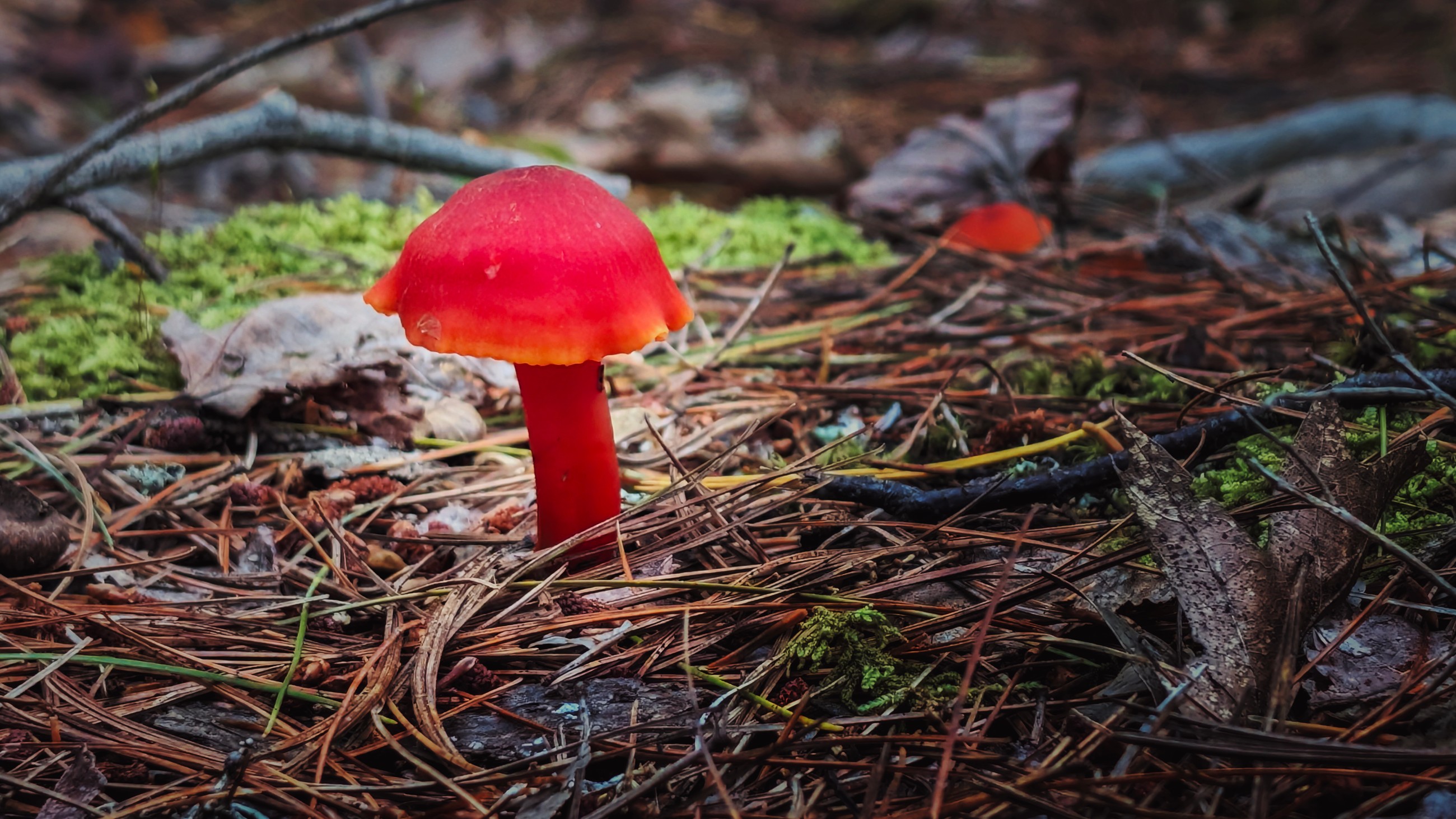
Scarlet-orange waxcaps
Likely Hygrocybe spp.; H. coccinea is a candidate
Genus likely; species unresolved
A single red-stemmed mushroom with a scarlet cap and orange-yellow margin. Its underside is hidden.
Evidence, uncertainty & references
Why this identification: Red-orange caps and similarly coloured slender stems suggest waxcaps. In the wider view, exposed yellow-orange gills add support.
What remains uncertain: H. coccinea is a plausible smooth-capped candidate. H. miniata and other red waxcaps remain possible. Cap texture, gill attachment, measured size and spores are needed; similar colour does not prove every photographed cluster is the same species.
Compare: Hygrocybe coccinea · Hygrocybe miniata
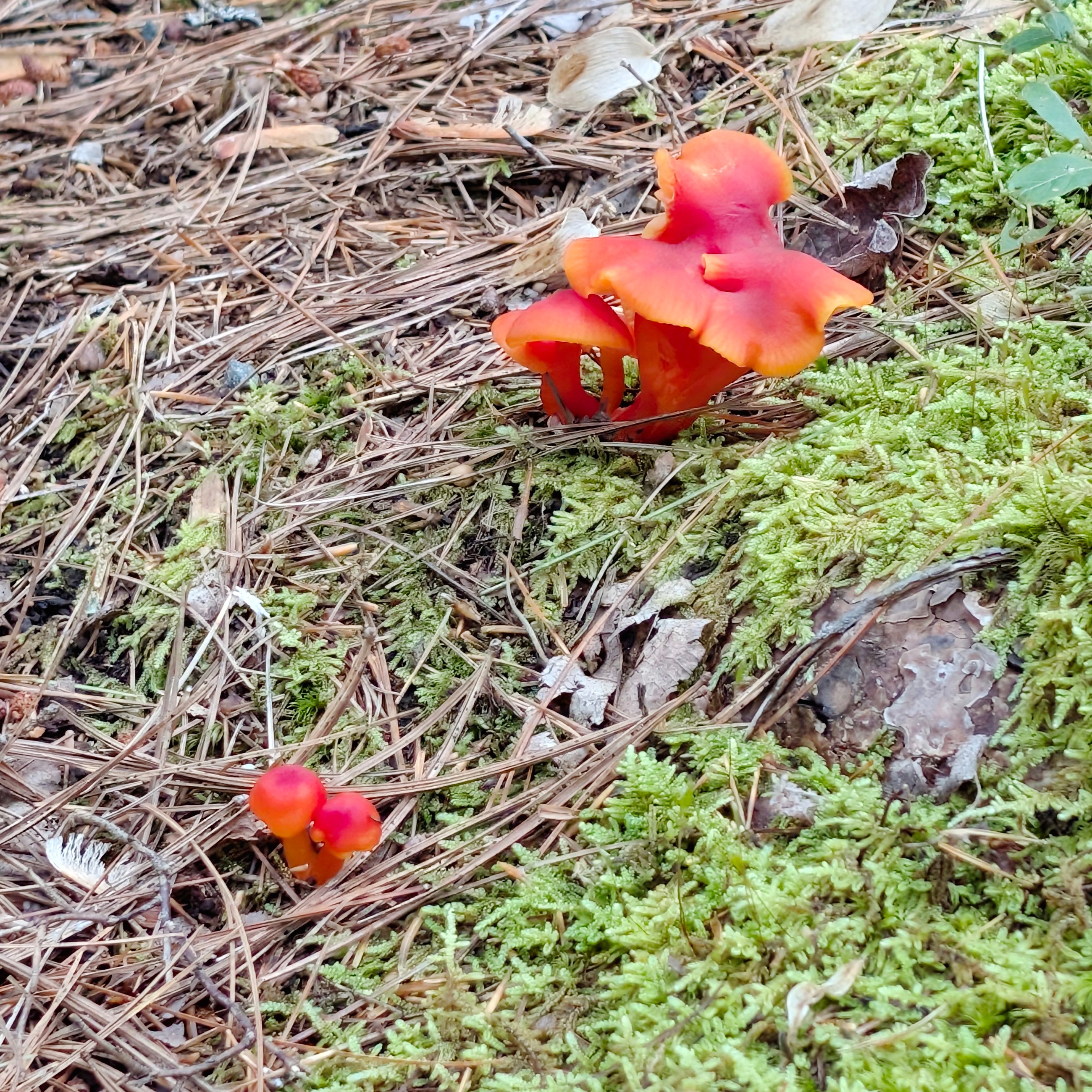
Scarlet-orange waxcaps
Likely Hygrocybe spp.; H. coccinea is a candidate
Genus likely; species unresolved
Red-orange mushrooms at several stages of cap expansion among moss and needles.
Evidence, uncertainty & references
Why this identification: Red-orange caps and similarly coloured slender stems suggest waxcaps. In the wider view, exposed yellow-orange gills add support.
What remains uncertain: H. coccinea is a plausible smooth-capped candidate. H. miniata and other red waxcaps remain possible. Cap texture, gill attachment, measured size and spores are needed; similar colour does not prove every photographed cluster is the same species.
Compare: Hygrocybe coccinea · Hygrocybe miniata
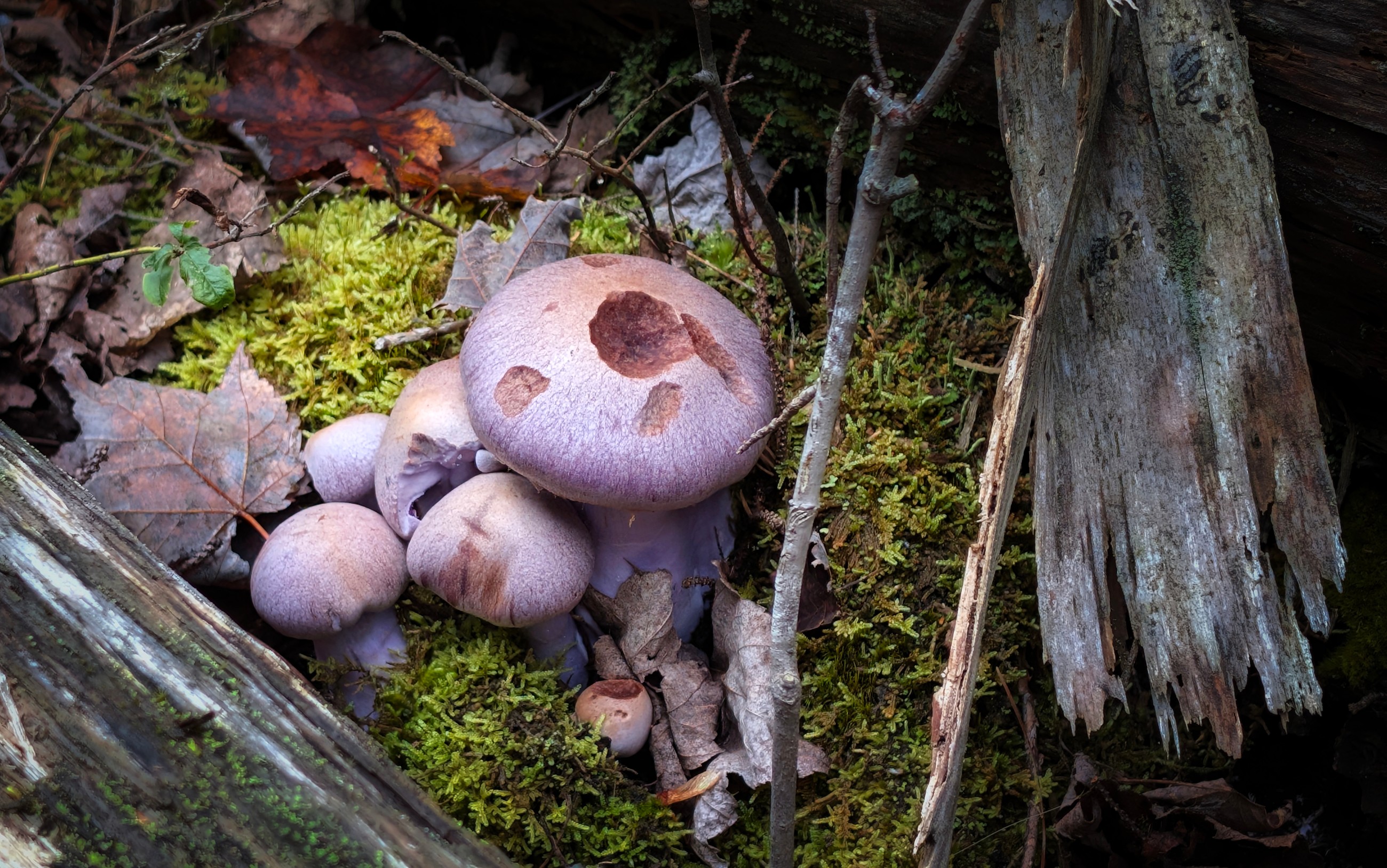
Violet webcap candidate
Likely Cortinarius sp.; compare C. iodes / C. iodeoides
Genus candidate; species unresolved
A compact violet cluster beside decaying wood. Proximity to the log does not prove growth from it.
Evidence, uncertainty & references
Why this identification: Lilac caps and stout violet stems are conspicuous. Tan patches on the caps resemble the colour pattern of the C. iodes / iodeoides pair.
What remains uncertain: Some tan patches may be damaged surfaces. Cap sliminess, a cortina and rusty spores are not confirmed. Other violet mushrooms remain possible. C. iodes and C. iodeoides cannot reliably be separated visually; microscopy is needed.
Compare: Cortinarius iodes and look-alikes
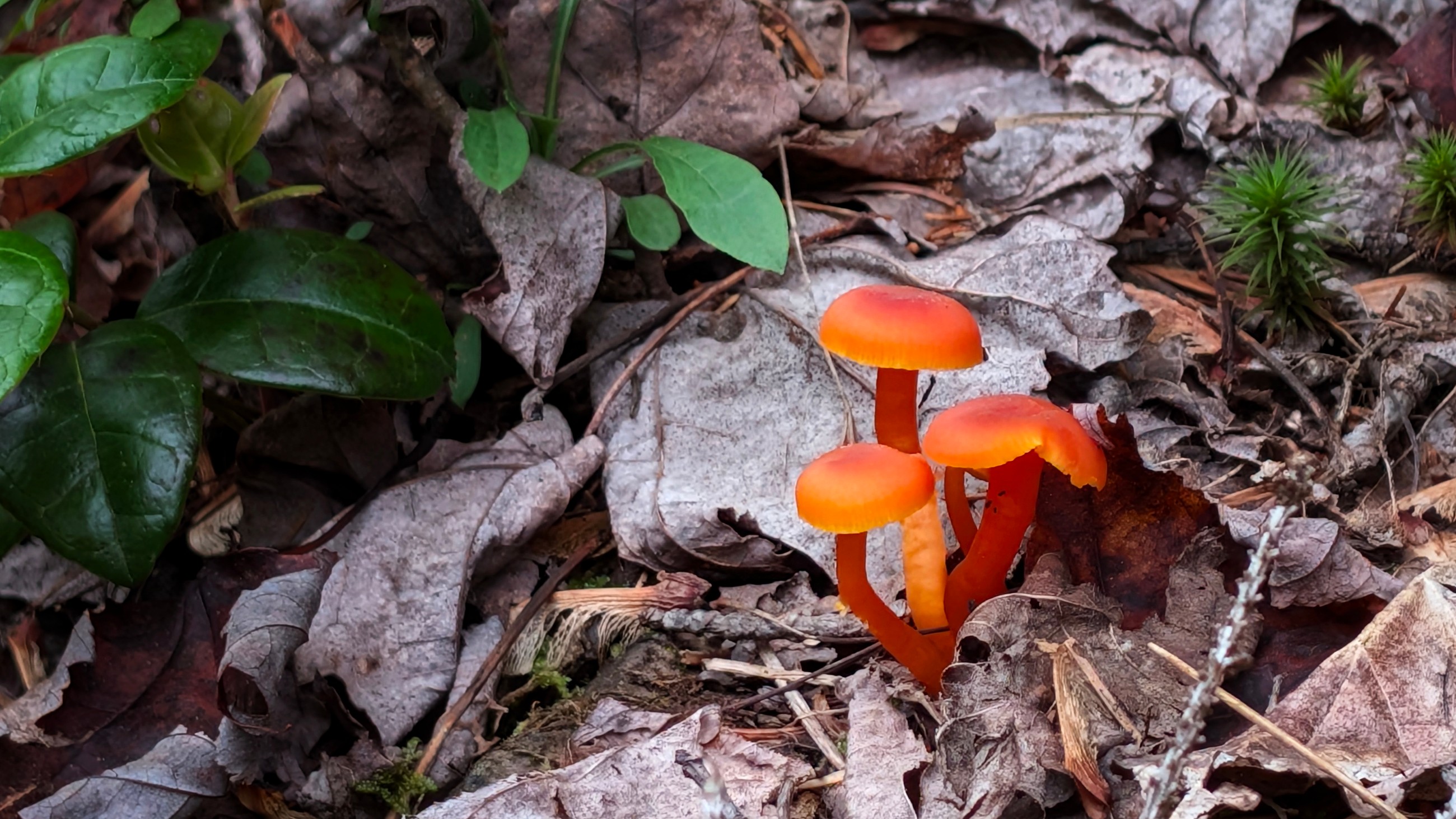
Scarlet-orange waxcaps
Likely Hygrocybe spp.; H. coccinea is a candidate
Genus likely; species unresolved
Three smooth-looking orange-red caps on slender matching stems.
Evidence, uncertainty & references
Why this identification: Red-orange caps and similarly coloured slender stems suggest waxcaps. In the wider view, exposed yellow-orange gills add support.
What remains uncertain: H. coccinea is a plausible smooth-capped candidate. H. miniata and other red waxcaps remain possible. Cap texture, gill attachment, measured size and spores are needed; similar colour does not prove every photographed cluster is the same species.
Compare: Hygrocybe coccinea · Hygrocybe miniata
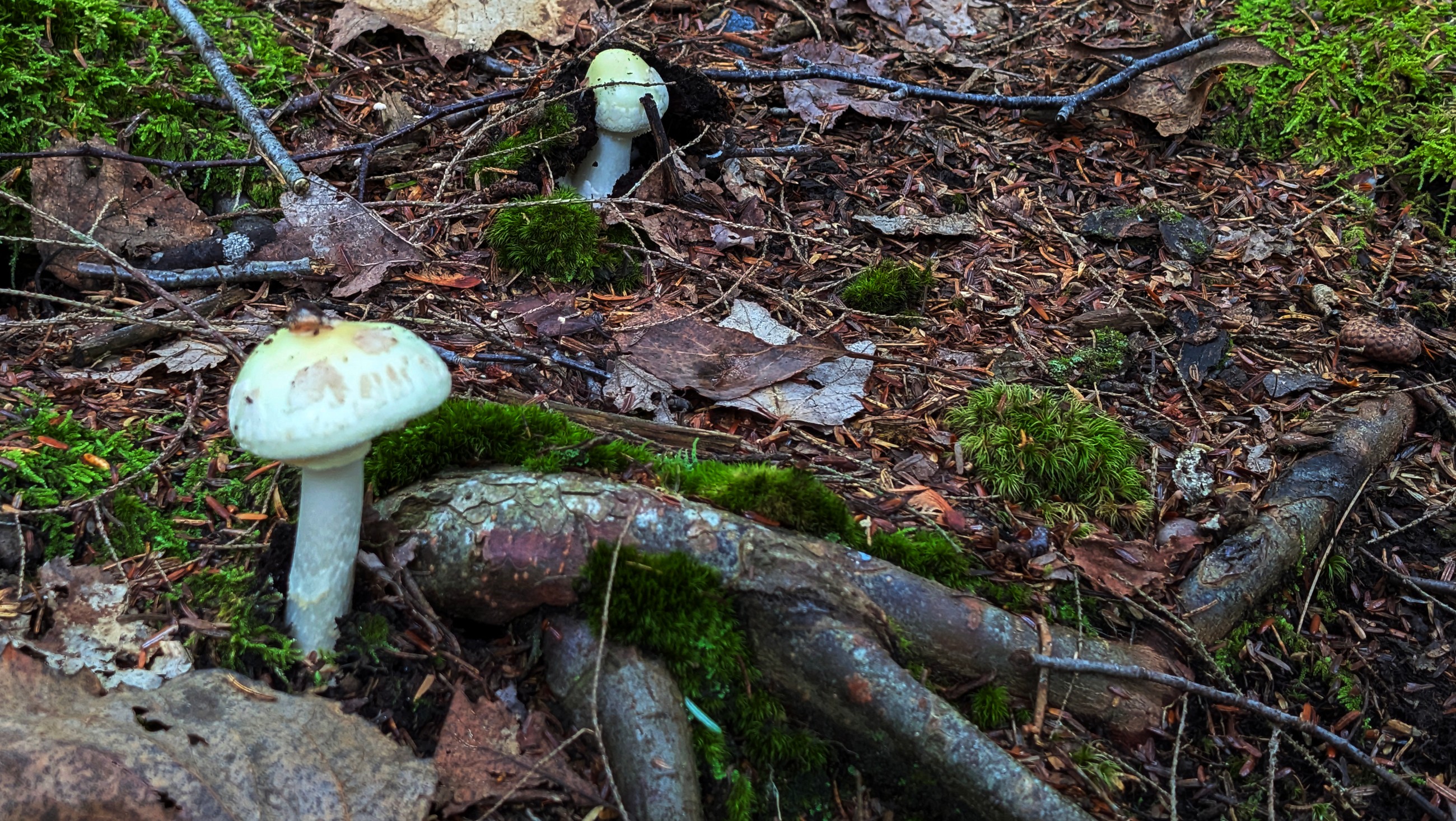
Pale yellow Amanita candidate
Likely Amanita sp.; compare the North American citrina-like group
Genus likely; species confidence low
Two pale, patch-capped mushrooms on the forest floor, one still young.
Evidence, uncertainty & references
Why this identification: Pale yellow-green caps carry irregular pale patches above white stems. A pale band beneath the foreground cap is consistent with veil tissue.
What remains uncertain: The stem bases, volvas and gills are concealed. A citrina-like Amanita is one possibility, but the image does not justify a species name. Other pale Amanita species remain possible; full stem-base and underside photographs would help.
Compare: North American citrina-like Amanita

Honey mushroom candidates
Likely Armillaria spp.
Genus likely; species unresolved
A slug on brown mushroom caps. The identification draws on the broader stump-cluster photograph as well as this detail.
Evidence, uncertainty & references
Why this identification: The wider stump photograph shows a dense cluster with honey-brown, finely scaly caps, pale fibrous stems and apparent veil remnants. These features suggest Armillaria.
What remains uncertain: The macro views are interpreted alongside the wider cluster photo, without assuming specimen identity is proven. Pholiota remains a comparison. A white spore print would support Armillaria; a brown print would redirect the identification. Species cannot be assigned here.
Compare: Honey mushroom features and limits · Scaly Pholiota comparison
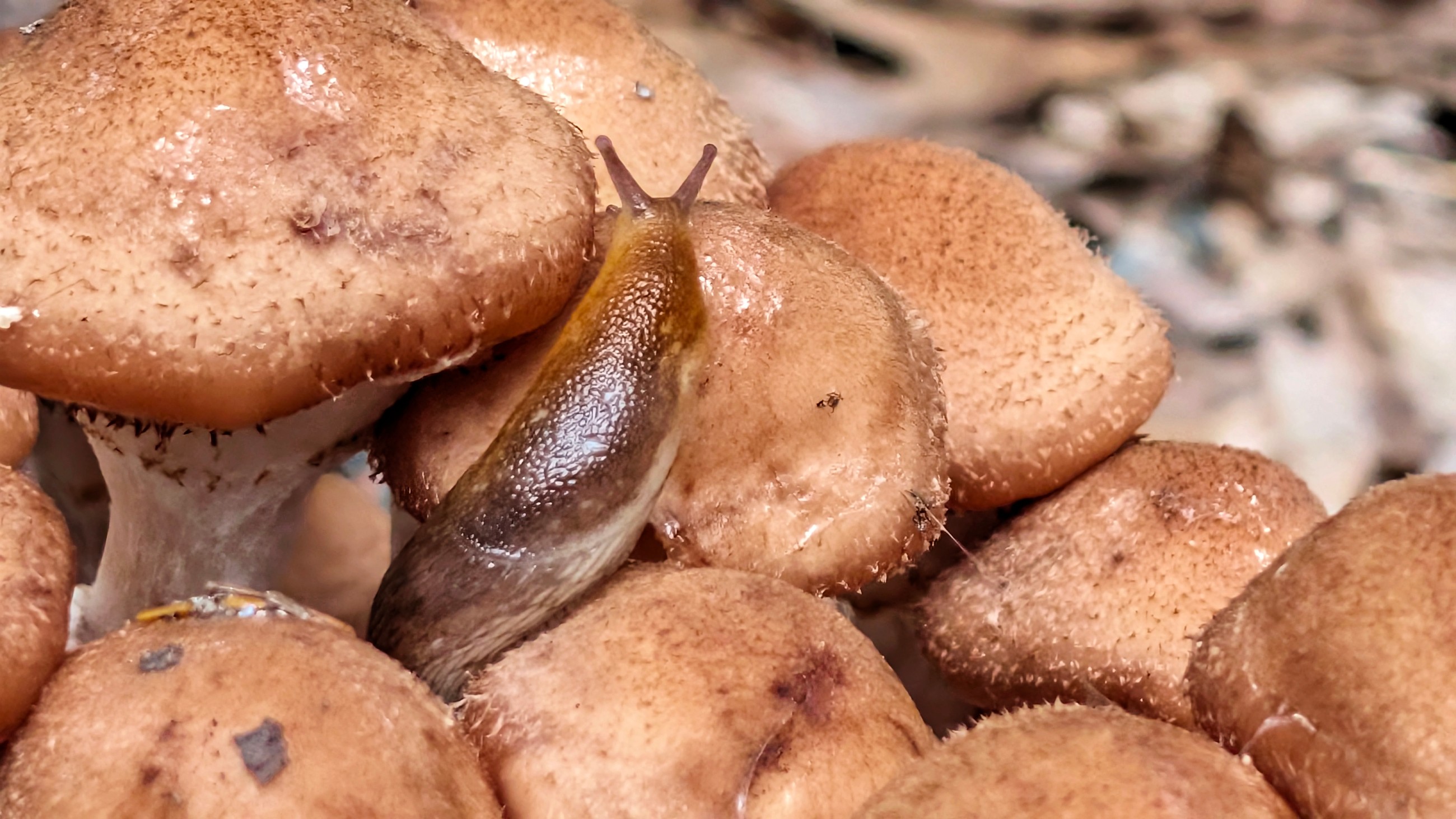
Honey mushroom candidates
Likely Armillaria spp.
Genus likely; species unresolved
Side view of a slug crossing the clustered caps, with pale mushroom tissue visible below.
Evidence, uncertainty & references
Why this identification: The wider stump photograph shows a dense cluster with honey-brown, finely scaly caps, pale fibrous stems and apparent veil remnants. These features suggest Armillaria.
What remains uncertain: The macro views are interpreted alongside the wider cluster photo, without assuming specimen identity is proven. Pholiota remains a comparison. A white spore print would support Armillaria; a brown print would redirect the identification. Species cannot be assigned here.
Compare: Honey mushroom features and limits · Scaly Pholiota comparison
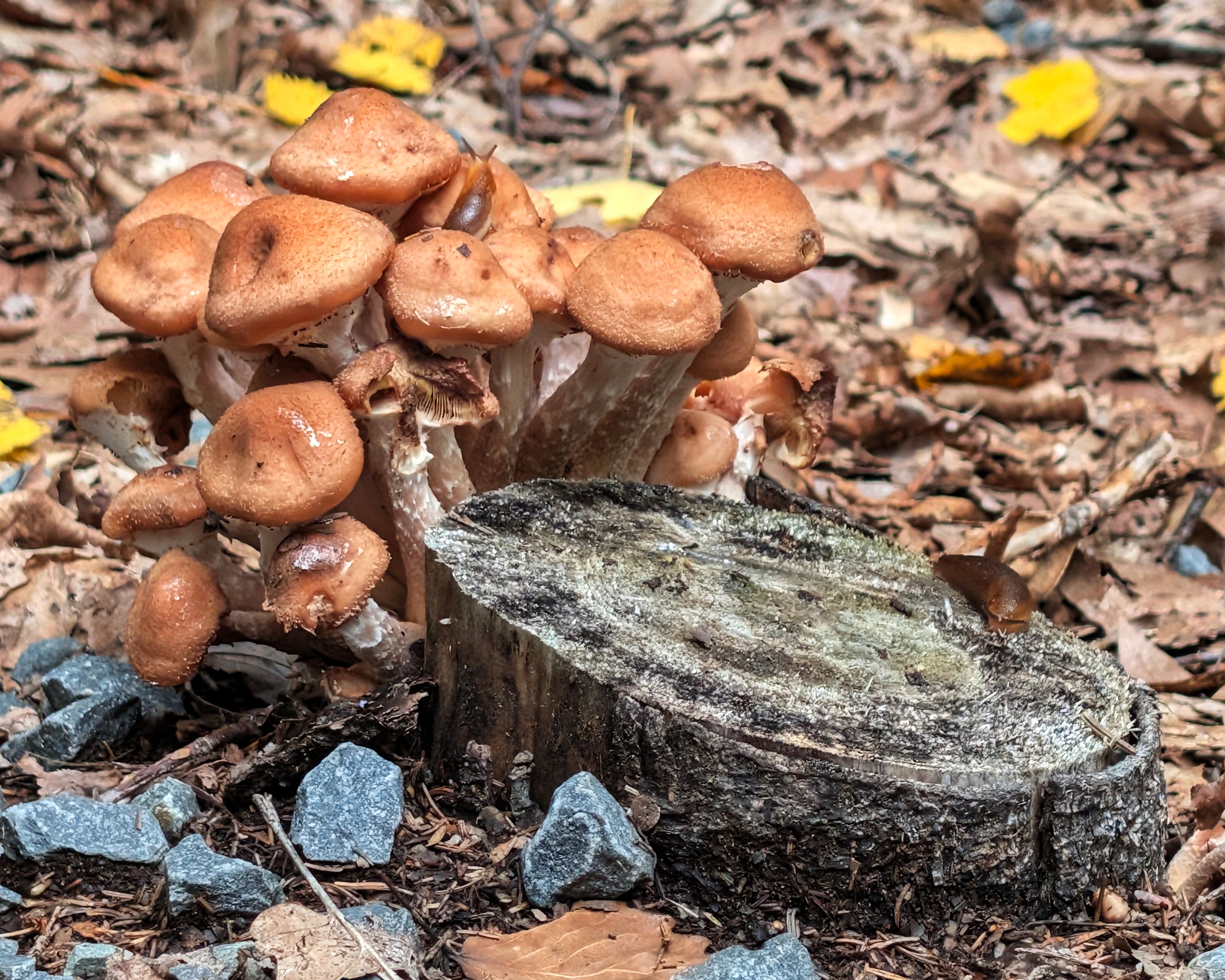
Honey mushroom candidates
Likely Armillaria spp.
Genus likely; species unresolved
The most informative view of this cluster: cap texture, pale stems and growth at a stump are visible.
Evidence, uncertainty & references
Why this identification: The wider stump photograph shows a dense cluster with honey-brown, finely scaly caps, pale fibrous stems and apparent veil remnants. These features suggest Armillaria.
What remains uncertain: The macro views are interpreted alongside the wider cluster photo, without assuming specimen identity is proven. Pholiota remains a comparison. A white spore print would support Armillaria; a brown print would redirect the identification. Species cannot be assigned here.
Compare: Honey mushroom features and limits · Scaly Pholiota comparison
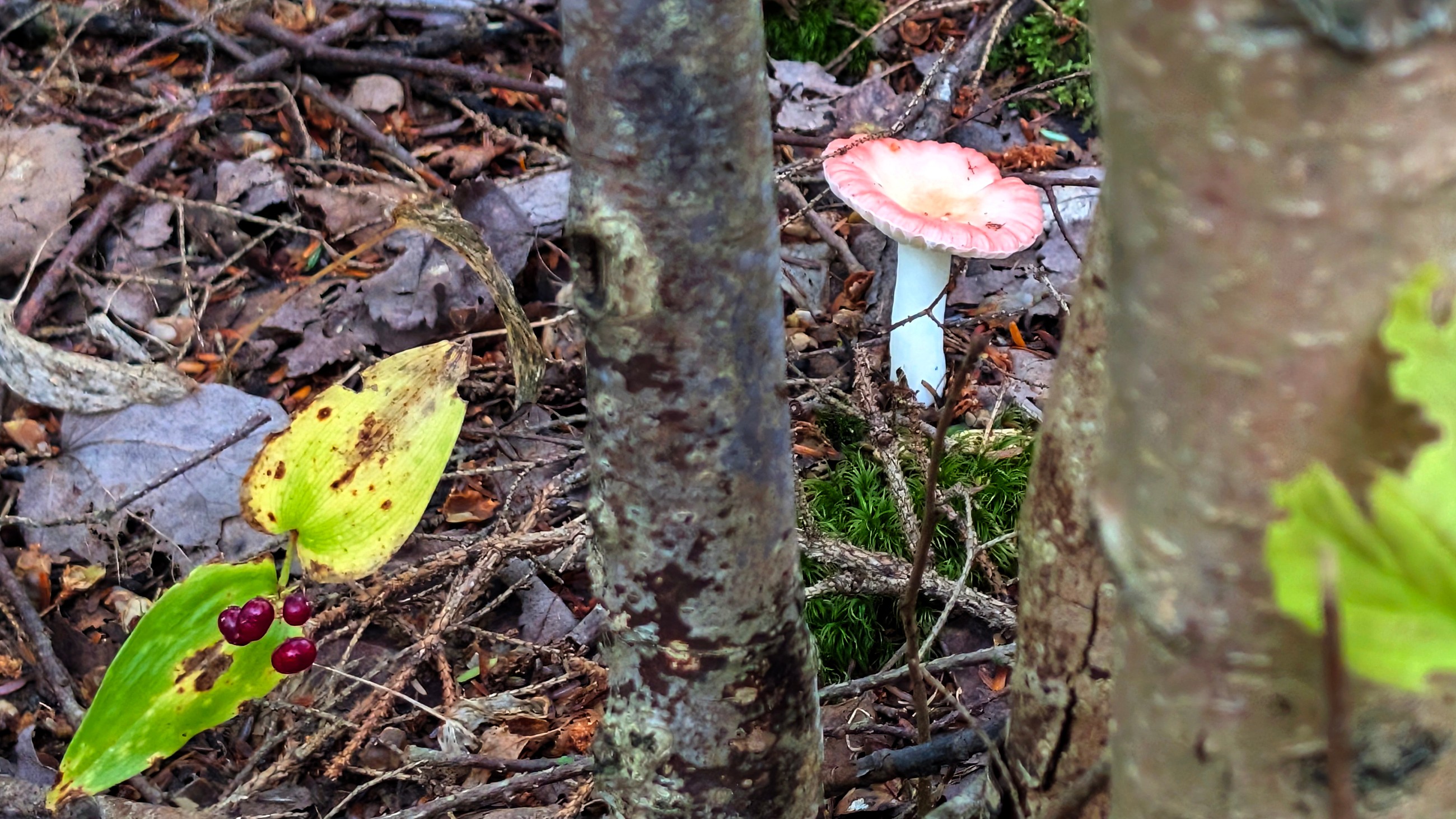
Pink-red brittlegill candidate
Likely Russula sp.
Genus likely; species unresolved
A pink-red mushroom beyond the saplings, with a pale stem and depressed cap.
Evidence, uncertainty & references
Why this identification: A pink-red, centrally depressed cap sits on a stout white stem. Pale gills are partly visible at the cap edge, with no obvious stem ring.
What remains uncertain: Brittle flesh has not been tested, and the stem base is hidden. Many Russula species share this appearance; cap colour alone does not establish R. emetica or any other species. Underside detail and spore characters would help.
Compare: Russula identification
About this notebook
All 15 files have ACDSee Ultimate 2026 recorded in their software metadata. They are the newest files by Date modified, selected from the 46 JPEGs in the source folder. Modification times describe saved files, not the order of sightings.
The current hosted Codex model visually reviewed all 15 photographs and compared candidate features with the linked MushroomExpert references on 1 October 2026. The names here are inferences from photographs, not expert-confirmed records. Similar-looking photos have not been assumed to prove the same species. No specimen, spore print or microscopic examination was available.
The gallery and its resized image copies work offline. Your original photographs are unchanged. Reference links need an internet connection if opened. For a closer identification on a future walk, useful photographs include the underside, the complete stem base, the attachment to wood or soil, and a size reference.
This post documents an experimental creative workflow using AI vision, image generation, and design synthesis with Codex. All mushroom identifications are visual and provisional; they must not be used to judge edibility.
From Forest Floor to Woven Tapestry: An Easy 6-Prompt Process
What began as 15 casual mushroom snapshots in Halifax’s Hemlock Ravine Park evolved through a smooth, 6-prompt iterative conversation with AI (Codex). Without complex prompt engineering or multi-step software, a simple conversation transformed raw field photography into provisional taxonomic identifications, a unified studio still life, and loom-ready woven tapestry designs.
Field Vision Review
Visual inspection of the 15 photos identified candidate genera—waxcaps, jelly fungi, club fungi, and brittlegills—with qualitative confidence tags.
Studio Composition
A single prompt combined all observed species into a cohesive, high-end studio still life, balancing ten distinct forms into one photographic plate.
Loom Translation
Consulting Adrian’s GitHub weaving rules (FiberPattern), the palette was converted into woven texture, simplified color blocks, and a 20×30″ loom concept.
The Resulting Concepts
Click any image to enlarge in full high-resolution.
1. The Studio Still Life
Synthesizing 10 distinct fungal forms observed along the trail into a single high-end photographic still life.
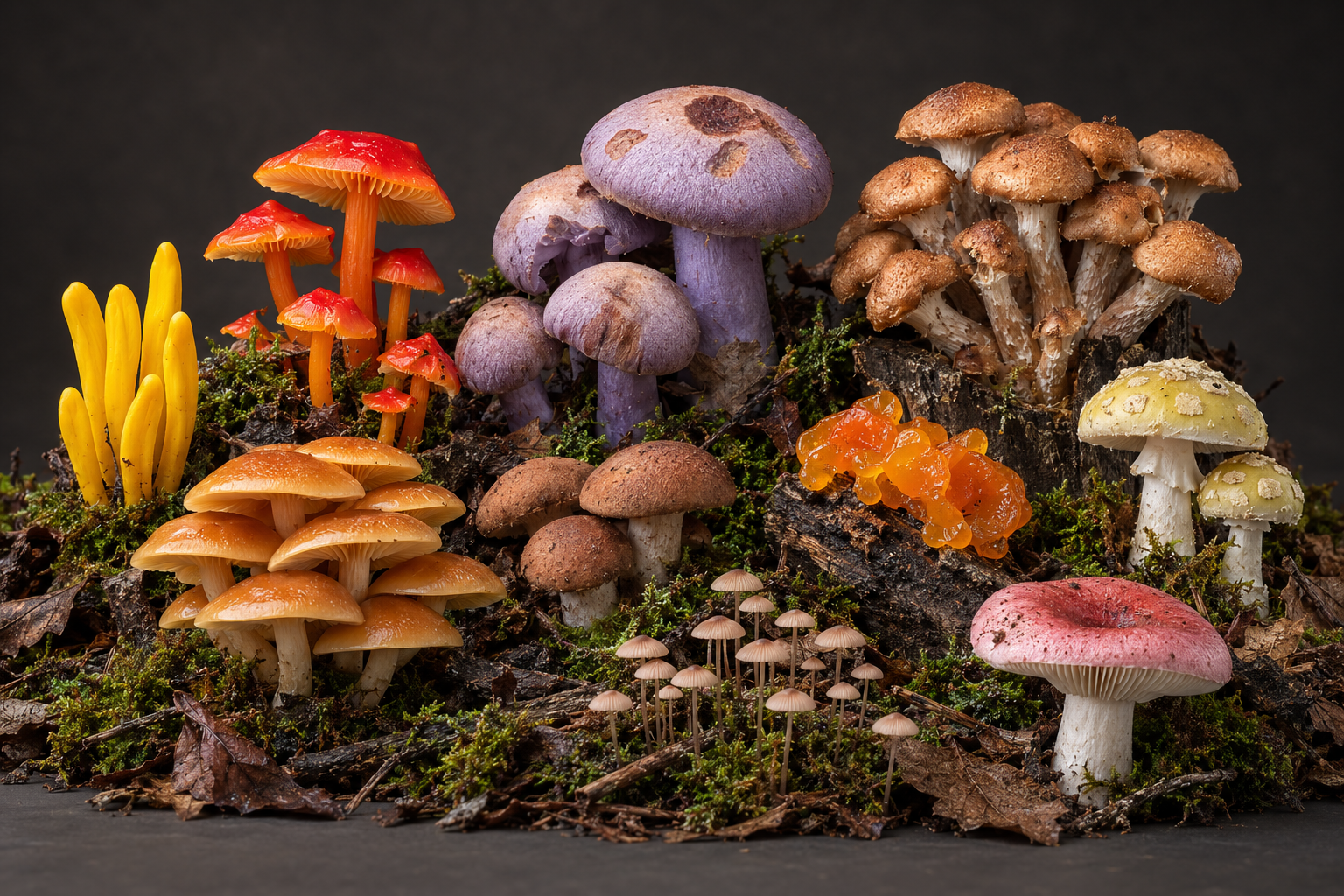
🔍 Open full resolution image · 📄 Read exact generation prompt (.txt)
2. Large Wall Tapestry Concept
Translating the forest palette into woven texture, simple shapes, and fringes based on the FiberPattern weaving framework.
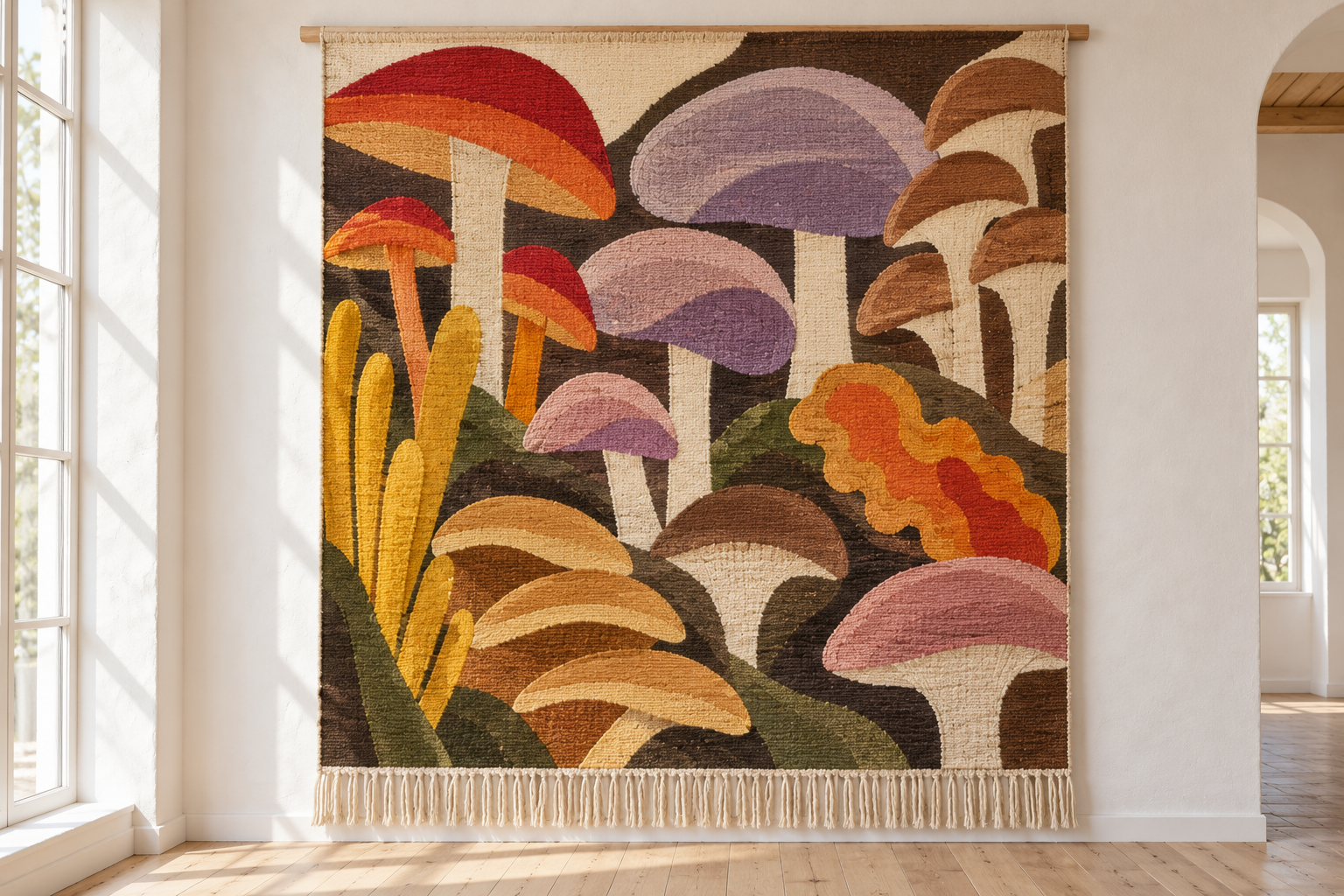
🔍 Open full resolution image · 📄 Read exact generation prompt (.txt)
3. Scaled 20 × 30-inch Loom Product Concept
A scaled-down design proportioned specifically to fit within a 45-inch floor loom weaving width.

🔍 Open full resolution image · 📄 Read exact generation prompt (.txt)
Explore the Full 6-Prompt Conversation Record (Click to Expand) Read the verbatim prompt exchanges and progress notes between Adrian and Codex
Exact prompts and replies
Exchange 1 — Adrian
This folder: "Hemlock Ravine photo folder" – I'm not sure if you are able to determine the edited images based on timestamp? Looking for the 15 newest ones by "date modified". I didn't edit them all – what I want: 1. create a html page with the images of the mushrooms /fungi. 2. Use whatever LLM (chatgpt's image viewing one? My local ollama?) – I want you to identify the fungi and state your confidence level; and put that on the html page under the mushroom? Just a local web page please; not a 'openai site'. {review; then determine if you need more info; then I will confirm}
Codex — progress update
I’ll review the folder and the 15 most recently modified files, then check the options for identifying them. I’ll keep this read-only until you confirm the page plan.
Codex — progress update
The folder is accessible, and its timestamps show a group of files modified after the initial batch. I’ll check their filenames and formats to see whether the newest 15 are plausible edited selections. I’m also using the quality-first model-routing skill to check the local Ollama option.
Codex — reply
Yes—this is feasible. I reviewed the folder read-only and visually checked five sample photos.
I found 46 JPEGs. The 15 newest by Date modified all contain ACDSee Ultimate 2026 metadata, supporting that they were edited or exported. There are actually 16 files with that metadata; selecting exactly 15 excludes PXL_20261001_172152740.jpg.
My proposed page:
- A local, offline HTML gallery with 15 photos and click-to-enlarge.
- Beneath each: likely identification, low/moderate/high confidence, visible supporting features, and any unresolved alternatives.
- Identification at genus or group level where the photograph cannot support a species name.
- A separate output folder containing the page and resized image copies, preserving your originals.
I can examine the images directly here. Your Ollama is also available with vision-capable gemma4:12b-it-qat, but I suggest direct review here plus checking fungal references for this small set. Confidence would describe the evidence available, not a measured probability or an edibility assessment.
Before you confirm, two details would help:
- Where were these photographed? Province/state and approximate locality are enough.
- Exactly the newest 15, or all 16 apparent edited images?
No files have been created or changed.
Exchange 2 — Adrian
I took all of these today in the Hemlock Ravine Park here in Halifax. Yes, 16 then.
Codex — progress update
I’ll use all 16 edited images and note Hemlock Ravine Park, Halifax, as the location. I’ll review each photo, check likely identifications against references, and build the local gallery with confidence notes beneath each image.
Codex — progress update
I’ve now viewed all 16 photos. Several show similar subjects, including red-orange waxcap-like mushrooms and a brown cluster with slugs. I’ll keep the identifications cautious: the photos often support a group or genus, while missing underside and stem-base details limit species-level confidence.
Codex — progress update
The captions are ready. The orange jelly fungus is distinctive as a fungal form, but I’ve left its genus uncertain because the wood and attachment details aren’t clear. I’m now generating resized, colour-managed copies for the page and checking the gallery’s layout and enlarge controls.
Codex — progress update
The gallery has been built with all 16 photos and their captions. The source hashes confirm that the originals are unchanged.
The app’s browser blocks local file URLs, so I couldn’t check the rendered page there. I’m finishing the checks for image files, page links and JavaScript syntax; you’ll be able to open index.html directly in your usual browser.
Codex — reply
Created your local fungi gallery.
It includes all 16 photos, tentative identifications, confidence levels, uncertainty notes and reference links. Click a photo to enlarge it.
Open index.html in your usual browser. It works offline; keep its folder together. Your originals are unchanged.
File and JavaScript syntax checks passed. The app blocked local-file previews, so the rendered layout remains unverified. Identifications are provisional, not edibility guidance.
Exchange 3 — Adrian
Nice job – one image I had in there – can you identify the mushrooms in "PXL_20261001_174706781.jpg"
Codex — progress update
I’ll look closely at that photo and check the strongest identification candidates against references.
Codex — reply
My best tentative identification is pinwheel mushrooms (Marasmius species), with orange pinwheel (Marasmius siccus) the leading species candidate.
- Genus confidence: moderate
- Species confidence: low
The photograph shows pale peach, pleated umbrella-like caps on very slender brownish stems, scattered through leaf litter. Those features fit M. siccus, whose orange caps can fade substantially with age or dry conditions. MushroomExpert’s description
I wouldn’t confirm the species from this view: other Marasmius and some Mycena can look similar. A sharp underside photograph would help most—M. siccus should have widely spaced, pale gills.
For a caption, I’d use: “Pinwheel mushrooms — likely Marasmius, possibly M. siccus.”
Package illustration, added to this record:

Exchange 4 — Adrian
Create an image of all of these in the same photograph; carefully posed for photographing in a high-end studio.
Codex — progress update
I’ll create a studio still life that brings the fungi from your photos together, with careful lighting and a refined arrangement.
Codex — progress update
I’m using the image-generation skill, with your photos as references. I’ll include each distinct form—including the small pinwheel mushrooms—and preserve their visible colours and shapes in one arrangement.
Codex — reply
Download the studio still life.
Created with the built-in image generator using your photographs as references. Saved prompt.
Package illustration, added to this record:
Exchange 5 — Adrian
If you look at my github there is a tapesty guide tool; maybe under test.hensler.work; that might assist in your understanding or maybe it is in your history here; I want to create a palette for a tapestry weaving; in this instance I just want you to create an image of a large wall tapestry on a wall in a bright studio; the image is like a product shot. The weaving is representative of this mushroom/fungi palette. There are shapes reminiscent of mushroom/fungi in an artistic way that suits tapestry weaving.
Codex — progress update
I’ll look for the tapestry guide in your GitHub and prior project notes, then use the mushroom colours and forms to create a product-style image of a large woven wall tapestry in a bright studio.
Codex — progress update
I found FiberPattern’s tapestry guidance in your GitHub: simplified colour blocks, visible horizontal weaving and a fringed edge.
I’ll use that approach with gold, orange, scarlet, lavender, rose, moss green and earthy neutrals, shaping them into an abstract fungal composition.
Codex — reply
Download the tapestry product shot.
Created with the built-in image generator: simplified fungal forms, your woodland colours, woven texture and a bright studio setting. Saved prompt.
Package illustration, added to this record:
Exchange 6 — Adrian
WOW that is large; could one weave that on our 45 inch floor loom? But – please show me something more like 20×30 inches; I forget the size of our tapestry looms. Can be the same thing only smaller in a more suitable location if needed.
Codex — progress update
A 20 × 30-inch version would fit comfortably within a 45-inch weaving width, though this image alone can’t verify the loom’s suitability for tapestry. I’ll check the practical distinction and show the design at that smaller scale in a bright studio nook.
Codex — progress update
The earlier concept was about 63 inches wide, so it would exceed a 45-inch loom’s width as one piece. At 20 inches wide × 30 inches tall, width is no obstacle. Floor looms can be used for tapestry; firm, even tension and access to the work are the practical checks.
I’ll keep the same palette and motifs, arranged above a small console so the new size is clear.
Codex — reply
Yes—a 20 × 30-inch version fits your 45-inch weaving width. Floor looms can weave tapestry; firm, even warp tension and a suitable setup matter. Rebecca Mezoff’s guidance
Here’s the smaller tapestry concept, shown above a compact console for scale.
Created with the built-in image generator. Saved prompt.
Package illustration, added to this record: